Urban Terrace Market Intelligence · March 2026
Dubai 2026: AED 680 Billion
in Real Estate Sales.
This Is Not a Crash.
Dubai real estate market crash 2026 is the phrase filling Google right now. Here is the data-driven answer everyone needs to read before making any decision about Dubai property.
Dubai Real Estate Market Crash 2026: Is It Actually Happening?
Dubai real estate market crash 2026 fears are not supported by any objective transaction data. The Dubai Land Department recorded over AED 680 billion in total real estate transactions in 2025 — a 30% year-on-year increase — with 205,000+ residential sales registered. January 2026 produced AED 72.4 billion in transactions, the single strongest month in Dubai's history. Price growth is decelerating from 18–22% in 2024 to a projected 5–8% in 2026: a sign of market maturity, not structural failure. Cushman & Wakefield, Knight Frank, and Fitch all characterise 2026 as a stabilisation year. Selective pressure exists in mid-market apartment clusters with heavy supply pipelines — but no credible institution is projecting a market-wide crash.
Dubai real estate market crash 2026 is the search phrase flooding Google and the question arriving in every investor's inbox. And it is understandable. The DFM Real Estate Index has seen notable volatility. Regional geopolitical tension rattled sentiment in early Q1. Headlines about 120,000 incoming units have generated anxiety. But headlines and fundamentals are two entirely different things — and the analysis below is built entirely on the latter.
Dubai Real Estate Market Crash 2026: What Is Actually Driving the Fear?
Dubai real estate market crash 2026 fears have three distinct origins — and separating them is the first step to understanding what is actually happening.
Fear One: The DFM Real Estate Index
In the opening weeks of 2026, the Dubai Financial Market's real estate sub-index declined approximately 21% amid regional geopolitical tension. This is the number that has been widely — and incorrectly — reported as evidence of a property market crash. It is not. The DFM index tracks the equity value of publicly listed real estate companies: developer share prices, not physical property asset values.
This distinction matters enormously. When global risk sentiment deteriorates, equities sell off faster and deeper than physical assets — this is a documented phenomenon in every market cycle, in every country, across every decade. Liquid assets reprice instantly. Illiquid assets like property move slowly, governed by actual supply and demand in physical transaction markets. The same institutional investors selling Emaar shares on Monday morning are often submitting offers on Emaar apartments the same week.
Fear Two: The 120,000-Unit Supply Pipeline
Cushman & Wakefield and CBRE project approximately 120,000 new residential units scheduled for handover across Dubai in 2026. On paper, that is a confronting number. In practice, Dubai's construction sector has a well-documented and entirely consistent history of delivery delays. Asteco's historical tracking shows that between 40% and 60% of units scheduled for any given year are actually delivered 12 to 24 months later than planned. Applied to 2026's pipeline, the realistic on-market delivery figure sits closer to 50,000–60,000 units — spread across a city of 3.7 million people and an investor base spanning more than 170 nationalities.
Fear Three: Global Macro Pressure
Interest rate tightening in the US, UK, and Europe has reduced purchasing power for buyers financing in those currencies. Some investment flows from Western markets have moderated. However, Indian buyer demand — now confirmed as the single largest buyer nationality in Dubai property transactions by volume — accelerated through 2025 and into 2026, partially and then some offsetting Western softness. Chinese buyer interest is also recovering as travel and capital flow restrictions ease. The buyer pool for Dubai is global, diversified, and structurally multi-sourced. The dubai real estate market crash 2026 narrative rarely accounts for this depth.
When Goldman Sachs analysts reviewed Dubai's transaction data in Q1 2026, DLD weekly volumes in the weeks immediately following the DFM index drop were within 8% of the equivalent period in 2025 — a record year. The "crash" was happening on trading terminals. The physical market remained fully open and active.
Dubai Real Estate Market Crash 2026: What the Transaction Data Actually Shows
Dubai real estate market crash 2026 concerns exist in a vacuum if you do not examine the actual numbers from the Dubai Land Department. The official data paints a picture that is the direct opposite of a collapse.
2025 — A Year That Broke Every Record
The DLD's full-year 2025 results, published in January 2026, recorded total real estate transactions of AED 680 billion — a 30% increase on 2024's already-exceptional performance. Residential sales alone accounted for 205,000 registered transactions. To contextualise this: in peak pre-2008 years, Dubai's annual residential sales rarely exceeded 60,000 transactions. The market has not only recovered — it has structurally transformed into something categorically larger and more liquid.
Off-plan sales represented approximately 63% of all transactions in 2025, reflecting sustained confidence in developer projects and strong appetite for payment plan structures. Ready property transactions — the most reliable indicator of genuine end-user and investor demand — rose 22% year-on-year, driven by villa communities and waterfront districts.
January 2026 — The Month Nobody Talked About
Despite the geopolitical noise dominating headlines in early 2026, the DLD reported AED 72.4 billion in total real estate transactions in January alone — the highest single month in Dubai's recorded history. This figure received minimal mainstream coverage, running simultaneously with the DFM equity volatility story. It is the single most important data point for understanding the actual state of the physical property market in early 2026.
"In real estate, the data that matters is the transaction data. Everything else is noise. And the transaction data for Dubai entering 2026 is the strongest this city has ever recorded."
Vaneesh Manchanda, Managing Partner — Urban Terrace Real EstateTransaction Volume: 2025 vs Prior Year
| Period | Transaction Volume | Year-on-Year Change | Signal |
|---|---|---|---|
| Q1 2025 | AED 172.8B | +28.8% | Strong Growth |
| Q2 2025 | AED 167.4B | +30.2% | Strong Growth |
| Q3 2025 | AED 158.2B | +29.9% | Strong Growth |
| Q4 2025 | AED 181.6B | +30.9% | Record Quarter |
| January 2026 | AED 72.4B | +33.3% | All-Time Monthly Record |
Source: Dubai Land Department. Figures are estimated based on published DLD quarterly disclosures and January 2026 preliminary data.
What Growth Deceleration Actually Means
Knight Frank's 2026 Wealth Report projects Dubai residential prices will grow 5–8% in 2026, down from 18–22% in 2024. The dubai real estate market crash 2026 narrative treats this deceleration as evidence of collapse. The correct framing is the opposite: a city growing at 5–8% per annum is outperforming London (flat to slightly negative), Paris (negative in real terms), Singapore (0–2%), and New York (1–3%). Dubai's "slowdown" remains a strong positive return on a global comparative basis. The reference class matters.
Dubai Real Estate Market Crash 2026: The Supply Story Is More Nuanced Than Headlines Suggest
Dubai real estate market crash 2026 concerns are perhaps most loudly articulated around the supply pipeline — and this is where nuance matters most. The headline 120,000-unit figure conceals a more complex reality that changes the investment calculus entirely.
The Delivery Gap: Scheduled vs Actual
Dubai's construction sector has never once delivered its scheduled annual unit count on time, across any year on record. This is not a failure — it is a structural characteristic of large-scale masterplanned development in a fast-growing city. Asteco's delivery tracking, covering 2015–2025, shows that the average annual completion rate against scheduled handovers was approximately 45–55%. For 2026's 120,000-unit pipeline, this historically-calibrated figure suggests actual delivery of 54,000–66,000 units across the calendar year — a figure consistent with Dubai's growth rate and population expansion, not a supply shock.
Not All Supply Competes With Each Other
The 120,000-unit aggregate obscures the most important market reality: product type and location determine competition, not raw numbers. A AED 600,000 studio in International City does not compete with a AED 25 million penthouse in Palm Jumeirah. These products serve entirely different buyer and tenant pools. The 2026 supply story is concentrated in mid-market apartments — studios, one-beds, and two-beds in price bands from AED 500,000 to AED 2 million — in communities including Jumeirah Village Circle, Dubai Sports City, Arjan, and Dubailand. Luxury, branded, and waterfront residential in prime locations face the opposite dynamic: chronic undersupply against sustained demand.
Area Risk Assessment — 2026
| Community | Supply Risk | Demand Drivers | 2026 Price Outlook |
|---|---|---|---|
| Jumeirah Village Circle | High | Rental investors, young professionals | Flat to –3% |
| Dubai Sports City | High | Mid-market rental demand | Flat to –2% |
| Dubai Hills Estate | Low | End-users, HNW families, schools | +6–9% |
| Arabian Ranches | Very Low | End-users, established community premium | +5–8% |
| Palm Jumeirah | Very Low | Global HNW, luxury, branded residences | +8–13% |
| Downtown Dubai | Low | Global investors, corporate demand | +6–10% |
| Dubai South | Medium | Airport-driven, long-term growth play | +3–6% |
| Creek Harbour | Medium-Low | Waterfront, infrastructure-backed | +5–8% |
Source: Urban Terrace Research, drawing on Asteco Q1 2026 Supply Report, ValuStrat Capital Values Index, and Betterhomes Market Tracker.
Mid-market apartments in high-supply corridors — particularly JVC, Dubai Sports City, and parts of Arjan — carry meaningful price risk through 2026 as new inventory is delivered. Investors holding these assets on short-term horizons with leverage should review their exit strategy carefully. Long-term holders in quality communities remain on solid ground.
Dubai Real Estate Market Crash 2026: Why Demand Is Not Going Anywhere
Dubai real estate market crash 2026 projections consistently underestimate the structural demand drivers that make Dubai unlike any other comparable real estate market in the world. These are not marketing talking points — they are quantified, documented, and durable.
The Golden Visa Programme — A Structural Demand Engine
Since the Golden Visa programme was expanded in 2022 to include property investors purchasing at AED 2 million and above, Dubai has processed hundreds of thousands of applications. Henley & Partners estimates that over 200,000 Golden Visas were issued in 2024 alone, representing the equivalent of a small European city's population committing to long-term UAE residency. Each visa holder carries a strong incentive to own rather than rent — anchoring genuine long-term housing demand that did not exist five years ago. This is not a cyclical demand driver. It is a structural immigration reform.
Population Growth: The 2040 Target
Dubai's population stands at approximately 3.7 million at the start of 2026. The Dubai 2040 Urban Master Plan targets 5.8 million residents — an increase of 2.1 million people in 14 years. At an average household size of 2.8 persons, that represents demand for approximately 750,000 additional residential units. Even the most aggressive supply projections do not come close to meeting this long-term structural need. The arithmetic of population growth and housing demand, across any multi-year horizon, is unambiguously pro-property in Dubai.
The Zero-Tax Structural Advantage
Dubai offers something that London, New York, Singapore, Paris, and Sydney cannot: a zero-tax property investment environment. This means zero capital gains tax on property sales, zero annual property tax, zero income tax on rental income, and 100% profit repatriation for foreign investors with no restrictions. These are not temporary policy positions — they are enshrined in UAE federal law and have been consistent across decades. The post-tax net return differential between Dubai and comparable global cities is significant and persistent.
Indian Buyer Dominance — The Structural Demand Flow
ANAROCK and fäm Properties data confirm that Indian nationals represent the single largest buyer group in Dubai real estate as of 2025, overtaking British and Russian buyers who had historically dominated. ANAROCK estimates Indian HNW investors allocated approximately USD 3.2 billion to Dubai property in 2024. Several factors sustain this flow: India's expanding high-income professional and entrepreneur class, the established Indian diaspora in the UAE, cultural familiarity with Dubai as a destination, and the strategic value of UAE residency for Indian families. This demand is structural, not cyclical — and the dubai real estate market crash 2026 narrative largely ignores it.
Golden Visa programme driving long-term residency commitments. Population growing from 3.7M to a target 5.8M by 2040. Zero capital gains tax, zero property tax, zero income tax on rental income. Indian buyers allocating USD 3.2B+ annually. 100% foreign ownership with no restrictions. These are not features that disappear in a down cycle. They are permanent competitive advantages.
Dubai Real Estate Market Crash 2026: Where Vaneesh Is Actually Looking to Buy
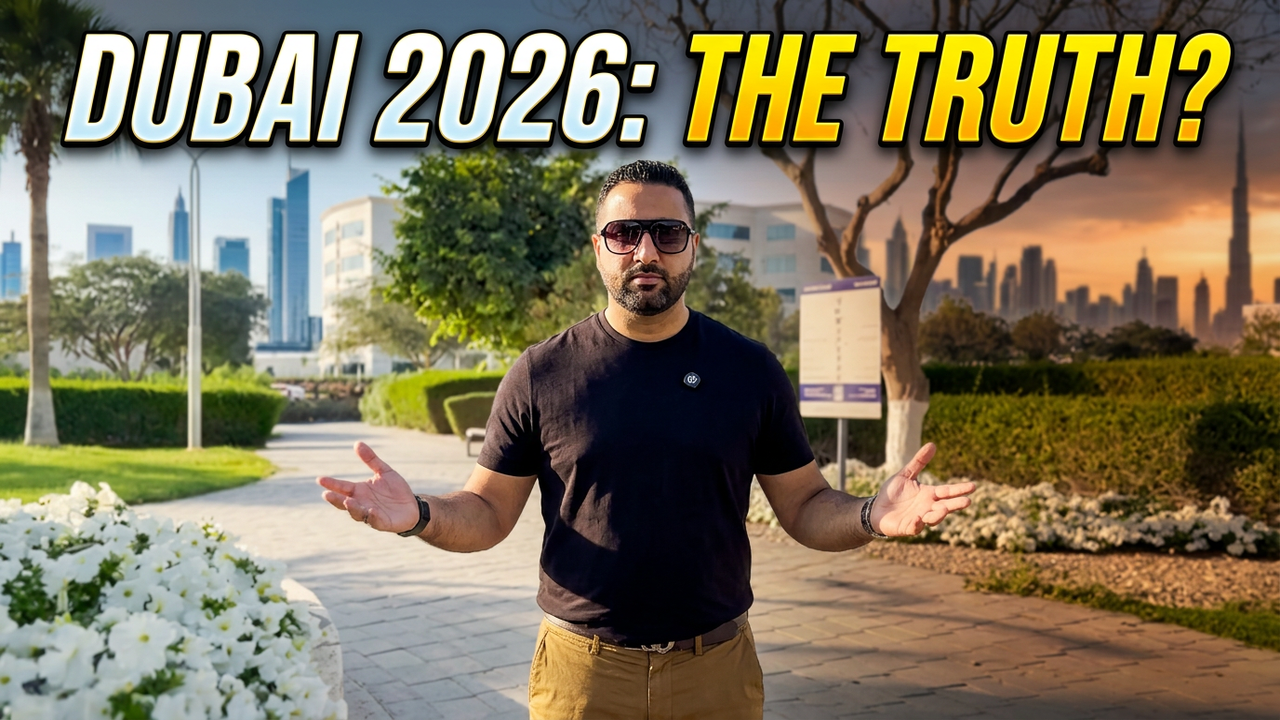
Dubai real estate market crash 2026 or not — the more important question for investors is always where to allocate capital. Vaneesh Manchanda, Urban Terrace Managing Partner, broke down his full 2026 market outlook in the video below. Watch it, then read the full analysis.
Watch: Vaneesh Manchanda — Dubai Market Breakdown 2026Tier One — Villas in Established Communities (Hold-Value Assets)
Dubai Hills Estate, Arabian Ranches, The Springs, The Meadows, and Jumeirah Golf Estates have delivered over 200% capital appreciation since the 2020 pandemic lows. ValuStrat's villa price index shows continued double-digit appreciation through full-year 2025. The primary driver is simple and structural: land scarcity. These are masterplanned communities built on finite, non-replicable land parcels surrounded by established schools, parks, hospitals, and community infrastructure. As Dubai's population grows, proximity to quality community amenity becomes a compounding premium — not a temporary one.
Rental yields for 4–5 bedroom villas in Dubai Hills currently run at approximately 5.5–6.5% gross — exceptional for a capital-growth asset class. End-user demand is genuine and deep. These are families choosing to put down roots in Dubai, not speculators chasing quarterly flips. The structural demand base for villa communities is amongst the most durable in Dubai's entire residential market.
Tier Two — Luxury and Branded Residences (Premium Outperformance)
Palm Jumeirah apartments, Downtown penthouses, DIFC residences, and Dubai Creek Harbour waterfront units maintained price momentum through the sentiment volatility of early 2026. Knight Frank's Prime Residential Index shows Dubai's ultra-prime segment — assets priced above USD 5 million — outperformed every comparable global luxury city in 2025, including Monaco, London, New York, and Hong Kong.
Branded residences — properties affiliated with luxury hotel brands such as Four Seasons, Atlantis, Dorchester, and Bulgari — command 20–35% price premiums over non-branded equivalents in equivalent locations. They attract a global buyer audience insulated from regional sentiment cycles, trade on brand equity as much as location, and are structurally supply-constrained by the limited number of partnerships between tier-one brands and tier-one developers. In an environment of general market uncertainty, scarcity assets outperform.
Tier Three — Infrastructure-Backed Entry Points (Long-Term Upside)
Dubai South, Expo City, and Creek Harbour represent the city's future, not its past. These are the districts where Dubai is building the infrastructure — airports, metro extensions, free zones, cultural institutions — that will anchor the next generation of population and economic growth. Entry price points in Dubai South start from AED 750,000 for a one-bedroom apartment from a reputable developer, providing one of the lowest barriers to entry for a Dubai address with genuine government-backed infrastructure commitment.
The Al Maktoum International Airport expansion — slated to eventually become the world's largest airport by passenger capacity — will make Dubai South one of the most strategically positioned addresses in the global economy over the next decade. Investors with a 7–10 year horizon and appetite for early-stage upside should be watching this corridor carefully.
The dubai real estate market crash 2026 narrative, paradoxically, is the strategic investor's friend. Periods of negative news flow create hesitation among retail buyers — reducing competition for the best assets at exactly the moment when informed capital should be moving. Institutional and experienced investors in every market cycle deploy during sentiment troughs, not at sentiment peaks. 2026 is a year to negotiate and secure — not a year to watch from the sidelines.
Dubai Real Estate Market Crash 2026: Why Rental Yields Change the Investment Thesis
Dubai real estate market crash 2026 analysis frequently omits the income component of the total investment return — and that is where Dubai's argument becomes most compelling for income-focused investors.
The Global Yield Comparison
Dubai offers gross rental yields of 5% to 9% depending on community, unit type, and service charge structure. This is not a feature of a market in distress — it is a function of Dubai's relatively low entry price points compared to comparable global gateway cities, combined with strong tenant demand from a large and growing professional expatriate population. The comparison to other major investment cities makes the case clearly:
| City | Gross Yield | Est. Net Yield | Capital Gains Tax | Annual Property Tax |
|---|---|---|---|---|
| Dubai | 5–9% | 4.5–8% | 0% | 0% |
| London | 2.5–4% | 1.5–3% | 28% | Council Tax (variable) |
| Paris | 2–3.5% | 1–2.5% | 19–36% | Taxe Foncière |
| New York | 2.5–4% | 1.5–3% | 20–37% | 0.8–2.1% p.a. |
| Singapore | 2.5–3.5% | 1.5–2.5% | 0% | 10–15% ABSD (foreigners) |
| Sydney | 2.5–3.5% | 1.5–2.5% | CGT applied (50% discount) | Land Tax |
Source: Knight Frank Global Residential Cities Index 2025; fäm Properties Dubai Market Report Q4 2025; JLL Global Real Estate Transparency Index.
The Net Return Differential in AED Terms
A AED 2 million apartment in Dubai Marina or Business Bay generating 7% gross rental yield produces AED 140,000 per annum in rental income — with zero tax leakage in Dubai. The equivalent investment in London, after income tax (20–45%), service charges, ground rent, and council tax provisions, produces a net return of approximately 1.5–2%. In AED-equivalent terms: roughly AED 30,000–40,000 per year on a comparable capital deployment. The gap is not marginal. It is decisive — and it is permanent under current tax regimes.
This yield differential is the primary reason why income-focused global investors — family offices, institutional allocators, and HNW individuals from India, Europe, and East Asia — continue to deploy capital into Dubai residential real estate regardless of short-term sentiment cycles. The dubai real estate market crash 2026 narrative does not address this arithmetic because there is no credible counter-argument.
Highest-Yielding Communities in 2026
Based on fäm Properties and Betterhomes Q4 2025 data, the highest gross yields currently available in Dubai by community type are: Dubai Marina studios and one-beds (6.5–8.5%), Jumeirah Village Circle apartments (7–9%), Business Bay studios and one-beds (6–8%), Dubai Hills villas (5.5–6.5%), and Palm Jumeirah apartments (4.5–6%). Investors must balance yield level against capital value stability — highest yields often cluster in highest-supply communities, which carry the most price risk in 2026.
8 Dubai Real Estate Market Crash 2026 Questions — Answered
The dubai real estate market crash 2026 is not happening by any objective measure. The Dubai Land Department recorded over AED 680 billion in transactions in 2025 — a 30% year-on-year increase — with 205,000+ residential sales registered. January 2026 alone saw AED 72.4 billion in transactions, the strongest single month in Dubai's history. Cushman & Wakefield, Knight Frank, and Fitch all describe 2026 as a period of stabilisation, not collapse. Price growth is slowing from 18–22% in 2024 to a projected 5–8% in 2026 — a natural market maturation, not a crash.
Source: DLD Full Year 2025 Report; Knight Frank 2026 Wealth Report; Fitch Ratings UAE Banking Sector NoteFears of a dubai real estate market crash 2026 have been driven by three factors: the DFM Real Estate Index declining approximately 21% in early 2026 during regional geopolitical uncertainty; concerns about 120,000 new units scheduled for handover; and global macro uncertainty including interest rate pressures in Western markets. The DFM index reflects equity sentiment about listed real estate companies, not actual property prices. Physical property transactions in Dubai remained robust, and historical data shows that Dubai's handover schedules consistently lag by 12–24 months, reducing the real supply impact significantly.
Source: DFM; Asteco Q4 2025 Delivery Rate Report; CBRE Dubai Market SnapshotThe dubai real estate market crash 2026 narrative significantly overstates its impact on prices. ValuStrat and Knight Frank project price growth of 5–8% across Dubai in 2026 — slower than the 18–22% surge of 2024, but firmly positive. The impact will be selective: mid-market apartments in oversupplied corridors like Jumeirah Village Circle and Dubai Sports City may see flat or marginally lower prices. Prime and luxury segments — Palm Jumeirah, Downtown Dubai, and waterfront properties — continue to attract strong HNW demand and are projected to outperform the market average by a significant margin.
Source: ValuStrat Dubai Residential Capital Values Index Q4 2025; Knight Frank Prime Residential Index 2026The areas facing the most risk amid dubai real estate market crash 2026 concerns are mid-market apartment clusters with heavy supply pipelines — primarily Jumeirah Village Circle, Dubai Sports City, International City, and parts of Arjan and Dubailand. These communities may face rental and price pressure as new units are delivered through 2026 and 2027. By contrast, established villa communities — Dubai Hills, Arabian Ranches, The Springs — and waterfront addresses — Palm Jumeirah, Dubai Creek Harbour — face undersupply relative to demand, providing a structural price floor. The risk in 2026 is location-specific, not market-wide.
Source: Asteco Q1 2026 Supply Report; Betterhomes Market Insights; fäm Properties Dubai Annual Review 2025The dubai real estate market crash 2026 fears, for the strategic investor, create opportunity rather than risk. Periods of negative sentiment historically coincide with reduced competition from retail buyers, creating entry windows for informed capital. Dubai's structural fundamentals — zero capital gains tax, zero property tax, 100% foreign ownership, Golden Visa eligibility, and 5–9% gross rental yields — remain entirely intact. Henley & Partners and CBRE data confirm that global HNW investor demand has not materially declined. The key is asset selection: established communities, tier-one developers, and prime or near-prime locations.
Source: CBRE Dubai Market Snapshot Q1 2026; Henley & Partners Global Wealth Migration Review 2025The dubai real estate market crash 2026 situation is fundamentally different from 2008 in every structural dimension. In 2008, Dubai's crash was driven by rampant speculation on unbuilt projects funded by cheap debt, with virtually no genuine end-user demand base. Today, DLD data reports that over 60% of buyers are end-users or long-term investors, not flippers. Mortgages are strictly regulated by the UAE Central Bank with mandatory LTV caps. Developer escrow requirements — introduced directly in response to 2008 — protect buyer deposits. Supply levels, while elevated, are a fraction of the speculative pipeline of 2008. The regulatory and economic infrastructure is categorically stronger.
Source: UAE Central Bank Mortgage Regulations; DLD Buyer Profile Data 2025; RERA Developer Compliance ReportsEvery major global research institution dismisses the dubai real estate market crash 2026 as a credible scenario. Knight Frank's 2026 Prime Global Cities Index projects 5–8% price growth for Dubai. Cushman & Wakefield describes the market as entering a healthy stabilisation phase after an exceptional multi-year growth cycle. Fitch Ratings notes that UAE bank exposure to real estate remains manageable, with no systemic credit risk evident. CBRE reports sustained HNW demand from European, Indian, and Russian buyer pools. ValuStrat's Dubai Residential Capital Values Index showed continued growth through Q4 2025. The institutional consensus: Dubai is maturing, not crashing.
Source: Knight Frank 2026 Wealth Report; Cushman & Wakefield UAE Outlook; Fitch Ratings UAE Banking Note; CBRE Q1 2026The strategic response to dubai real estate market crash 2026 concerns is to be selective, not sidelined. Investors should prioritise established villa communities and waterfront addresses over mid-market apartment clusters carrying supply risk. Off-plan investments should be restricted to RERA-registered projects from tier-one developers with proven delivery records — Emaar, Nakheel, Sobha, DAMAC, and Ellington. Payment plans on off-plan properties allow investors to enter at today's prices with staged capital deployment over 3–5 years. Infrastructure-backed communities — Dubai South, Expo City, Creek Harbour — position investors optimally for the city's 2040 population and economic targets.
Source: RERA Dubai Approved Developer Register; Dubai 2040 Urban Master Plan; Urban Terrace ResearchDubai real estate market crash 2026 is a headline, not a reality. The data from the Dubai Land Department, ValuStrat, Knight Frank, and Cushman & Wakefield collectively describe a market maturing from a super-cycle, not collapsing from one. AED 680 billion in transactions, 205,000 residential sales, and the strongest-ever January 2026 figure of AED 72.4 billion are not crash statistics. They are the numbers of a market that has permanently elevated its baseline and is now consolidating those gains at a healthier, more sustainable growth rate.
Dubai real estate market crash 2026 concerns have real, specific application — but only in specific locations and product types. Mid-market apartment clusters in oversupplied corridors will face flat or mildly negative price pressure as new inventory is delivered. Investors who bought into these communities at peak 2024 prices on short flip horizons may see compressed returns. But investors in established villa communities, luxury waterfront addresses, and infrastructure-backed growth districts are facing a fundamentally different risk-return profile — one that remains compelling by any global comparative standard.
Dubai real estate market crash 2026 is not the question that intelligent investors should be leading with. The question is: which community, which asset class, which developer, and at what entry price? That analytical discipline is what separates the investors who outperform from those who either panic out or chase the wrong asset at the wrong time. Urban Terrace's mandate is to ensure our clients are always asking the right questions — and getting data-driven answers. If you want to know exactly which projects and communities we are watching right now, the conversation starts below.
The Dubai Real Estate Market Crash 2026 story
is missing your next opportunity.