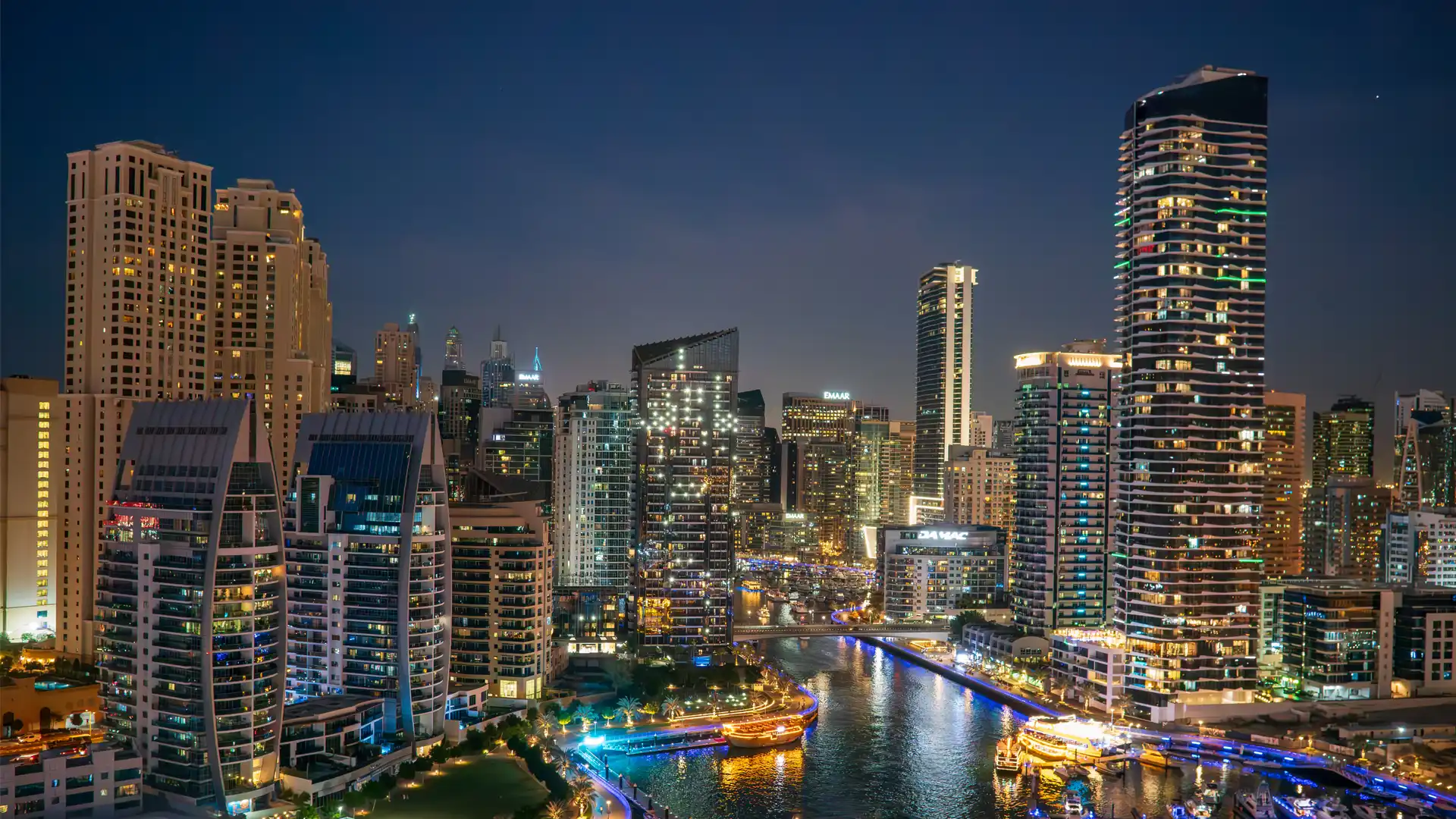
The Dubai property market crash 2026 is real in the stock market. The DFM Real Estate Index has fallen approximately 30% since February 27 — the worst decline in its history — erasing all 2026 gains. But actual property transactions have not crashed. Dubai recorded 3,570 sales deals worth AED 11.93 billion in the single week of March 2–9. An apartment at Aman Residences sold for AED 422 million during the conflict — the third most expensive in Dubai's history. The Dubai property market crash 2026 is a stock market story. On the ground, it is a sentiment pause, not a structural collapse.
Every investor is searching "dubai property market crash 2026" right now. The headlines are alarming. Bloomberg says UAE bonds are the worst in emerging markets. The DFM index is down 30%. Drone strikes hit Dubai International Airport. These are facts about the stock market. But the dubai property market crash 2026 story has two chapters — and most articles are only showing you one of them. This article tells you the other half.
Two Markets, Two Stories — Understanding What Is Actually Crashing
The most important thing to understand about the dubai property market crash 2026 narrative is that there are two completely separate markets being discussed as if they are one. The dubai property market crash 2026 in the headlines refers to equity markets — developer stocks listed on the DFM. The physical property market, where apartments are bought, sold and rented, operates on a completely different timeline and with a completely different buyer base.
The DFM index tracks developer equities — how publicly listed companies like Emaar, DAMAC and Aldar are valued on the stock exchange. Stock markets move instantly on sentiment. They price in fear and uncertainty in real time, often overshooting dramatically in both directions. Physical property prices are fundamentally different — they are supported by end-user demand, existing contracts, and a buyer base that is 90% cash-funded and 70% end-user driven.
The Data Nobody Is Showing You
Search "dubai property market crash 2026" and you will find hundreds of articles about the DFM index decline. Very few are showing you the transaction data running simultaneously. This is the full picture of the dubai property market crash 2026 — both the fear and the facts.
| Metric | Data Point | Source | Signal |
|---|---|---|---|
| DFM Real Estate Index | ~16,910 → ~11,700 (−30%) since Feb 27 | Dubai Financial Market / TradingView | Bearish |
| Weekly transactions (Mar 2–9) | 3,570 deals · AED 11.93 billion total value | Dubai Land Department | Active |
| Transaction value trend | Values rose over the last 3 days of the week | Dubai Land Department | Recovering |
| Secondary viewings | +75% in days 8–10 vs days 1–3 of conflict | Allsopp & Allsopp | Recovering |
| Buyer inquiries | ~45% below typical levels overall | Betterhomes | Caution |
| 2025 full-year transactions | AED 917 billion · 270,000+ deals — highest ever | DLD / Anarock | Record base |
| Jan–Feb 2026 transactions | AED 133.3 billion · 34,452 deals | DLD | Strong start |
| UAE corporate bonds | Worst performers in EM this month | Bloomberg index | Bearish |
| UBS Bubble Index rating | Dubai = moderate risk (Miami, Tokyo = high) | UBS Global Real Estate Bubble Index | Moderate |
"What we're seeing in the secondary market right now is stability, not panic. The last three days have shown a 75% increase in viewing activity compared to the first three days of the regional unrest — a clear sign that buyer and tenant confidence is returning."
Lewis Allsopp, Chairman — Allsopp & Allsopp · March 2026The AED 422 Million Signal
On March 5, 2026 — four days after the first Iranian drone struck Dubai International Airport — a 31,201 square foot apartment at Aman Residences Dubai on the Jumeirah Peninsula sold off-plan for AED 422 million ($115 million). At the peak of dubai property market crash 2026 fear, this was the third most expensive apartment transaction in Dubai's history.
For investors who owned Dubai property through the 2020 COVID lockdown, the 2022 Ukraine war, and the 2023 global rate hike cycle — the dubai property market crash 2026 fear will feel familiar. The Aman Residences AED 422 million transaction is a signal about where ultra-high-net-worth capital sits on the dubai property market crash 2026 question.
Ultra-high-net-worth buyers operate on a different calculus from retail investors. They are not watching the DFM index. They are watching long-term structural value: Dubai's regulatory framework, its position as a global wealth hub, and the irreplaceable scarcity of landmark assets. An AED 422 million off-plan purchase made four days into an active regional conflict is not a sign of recklessness. It is a signal that the most sophisticated capital in the market has made its assessment — and it is long.
As fäm Properties CEO Firas Al Msaddi noted after confirming the transaction: over 70% of Dubai transactions are now end-user driven, not speculative. The buyer base is globally diversified. Mortgage activity has doubled in four years. The regulatory environment has matured.
Which Segments Are Most at Risk in the Dubai Property Market Crash 2026
Not all segments of Dubai's property market face equal pressure. The dubai property market crash 2026 narrative applies very differently depending on what you own — or are considering buying. Here is the segment-by-segment breakdown of who is most exposed in the dubai property market crash 2026.
| Segment | Current Status | Risk Level | Outlook |
|---|---|---|---|
| Ultra-Luxury AED 20M+ | Paradoxically resilient. AED 422M Aman sale. UHNW buyers still deploying. | Low–Medium | Holds if conflict doesn't escalate beyond Q2 |
| Luxury AED 5M–20M | S&P warns softening possible if conflict persists. Buyers pausing, not cancelling. | Medium | Resilient in established areas (Downtown, Palm, Marina) |
| Mid-Market AED 1.5M–4M | Most pressure. Buyers negotiating 3–7% discounts. Due diligence periods extending 4–8 weeks. | Medium–High | End-user demand sticky, but investor demand pausing |
| Off-Plan (all price points) | Speculative activity slowed. 120,000+ units expected handover in 2026 — double usual volume. | High | Developers likely to offer creative payment plans |
| Completed Income Property | Most resilient segment. Rental income continues regardless of stock market moves. | Low | Strong — rental yields 6–9% in prime areas |
The specific risk in the dubai property market crash 2026 scenario is not a 2008-style collapse. It is a prolonged conflict that suppresses off-plan absorption at a time when 120,000 units are expected for handover — double the usual annual volume. That supply-demand imbalance is the real structural risk for the medium term, separate from the war entirely. The dubai property market crash 2026 fear is about sentiment. The supply pipeline is about fundamentals.
Why the Dubai Property Market Crash 2026 Is Not 2008
Every Dubai market selloff triggers the 2008 comparison. In the context of the dubai property market crash 2026, it is worth addressing directly — because the structural differences between now and 2008 are significant enough to change the entire investment calculus.
| Factor | 2008 Crash | 2026 Situation |
|---|---|---|
| Leverage / Debt | Heavily leveraged. Loose mortgage lending. Buyers flipping contracts before handover. | 90%+ of transactions cash-funded. Mortgage activity regulated and doubled — but from a low base. |
| Buyer Profile | Dominated by speculative investors. Many buying to flip, not occupy. | 70%+ end-users in 2025. Globally diversified buyer base across 100+ nationalities. |
| Regulation | Minimal escrow protection. Developer accountability limited. Off-plan sales largely unprotected. | DLD escrow system. RERA oversight. Developers required to pre-sell before accessing construction funding. |
| Trigger | Global financial system collapse. Credit markets froze. Buyers couldn't finance. | Regional geopolitical conflict. Sentiment shock. Physical financing market remains open. |
| UBS Bubble Risk Rating | N/A (pre-index) | Moderate — significantly below Miami and Tokyo (high risk) in current 2025 index. |
What History Says About Dubai Property in Crisis Years
The Dubai property market has faced five major external shocks since 2000. The pattern is consistent — and highly relevant to the dubai property market crash 2026 moment we are in right now.
| Event | Year | Initial Market Response | 12-Month Outcome |
|---|---|---|---|
| US-Iraq War | 2003 | Sentiment pause. Regional investor caution. | Property prices rose as capital sought Dubai safe haven status. |
| Global Financial Crisis | 2008–09 | Genuine structural crash. Prices fell 50%+ in some areas. | Recovery began 2010. Structural reform of regulation followed. |
| COVID-19 | 2020 | Transactions paused for 45 days during lockdown. | 2021 became the strongest transaction year in Dubai history at that point. |
| Ukraine War | 2022 | Russian capital outflow to Dubai accelerated. Prices rose. | 2022–2024 became a 3-year record-breaking run. Index up 63% in 2024 alone. |
| US-Israel-Iran War | 2026 | DFM index −30%. Bonds worst in EM. But 3,570 deals in one week. | TBD — depends on conflict duration and escalation. |
The 2008 crash is the only instance where a dubai property market crash was structural and sustained — and it was caused by a global credit collapse, not a regional military conflict. In every other case including today's dubai property market crash 2026, the initial fear was followed by a recovery that left long-term buyers significantly ahead.
"Dubai has navigated many global events and market cycles over the past four decades. The interest is still there. Buyers, sellers, tenants and landlords are watching closely and considering their next steps."
Louis Harding, CEO — Betterhomes · March 20268 Direct Questions Answered — Dubai Property Market Crash 2026
These are the questions being searched most right now about the dubai property market crash 2026. Each answer is sourced from live DLD transaction data, agency reports and analyst statements published this week.
The Dubai Financial Market Real Estate Index has fallen approximately 30% since February 27 — which is a stock market crash in developer equities. But actual property transaction prices have not crashed. Dubai recorded 3,570 sales deals worth AED 11.93 billion in the week of March 2–9. An AED 422 million apartment sold at Aman Residences during the conflict. Viewings rose 75% in the most recent three days. The Dubai property market crash 2026 is real in the equity market. In the physical property market, it is a sentiment pause, not a structural collapse.
Source: DLD transaction data · Allsopp & Allsopp · fäm Properties · March 2026The DFM Real Estate Index peaked at 16,910.3 on February 27, 2026 and has fallen approximately 30% to around 11,700 by mid-March 2026 — erasing all 2026 gains and representing the worst single-month decline since the index was established. The index had risen 63% in 2024 and 38% in 2023. This is an equity index tracking listed developer stocks — not actual property transaction prices, which are far slower to move and remain supported by end-user demand.
Source: Dubai Financial Market · TradingView · Business Standard · March 2026For investors with a 5+ year horizon, March 2026 is historically the type of entry point that generates strong long-term returns. Dubai property prices rose 60–75% since 2021 through multiple global crises. The current selloff follows the same fear-then-recovery pattern seen after the 2003 Gulf War, 2020 COVID lockdown, and 2022 Ukraine conflict. The risk is real — a prolonged conflict could pressure off-plan and luxury segments — but over 70% of Dubai transactions are end-user driven and 90% cash-funded. The structural long-term fundamentals have not changed. The war is a risk factor, not a structural collapse in the physical market.
Source: DLD · Anarock · S&P Global Ratings · UBS Bubble Index · March 2026As of March 14, 2026, actual property transaction prices have not materially fallen. Developer stock prices dropped ~30%. UAE corporate bonds became worst performers in emerging markets. Buyer inquiries fell approximately 45% as buyers adopted a wait-and-see approach. However, transactions continued — 3,570 deals worth AED 11.93B closed in one week. The AED 422M Aman Residences sale closed four days into the conflict. Secondary market viewings rose 75% in the latest three days compared to the conflict's opening days. Price per square foot in primary areas has remained firm.
Source: The National · DLD · Allsopp & Allsopp · Betterhomes · March 2026Several data points support a long-term investment case for 2026. UBS rates Dubai moderate risk vs Miami and Tokyo at high risk. Over 70% of transactions are end-user driven. 90% cash-funded. The AED 422M Aman sale signals UHNW buyers are still deploying. Completed income-generating properties offer 6–9% rental yields — among the highest in global prime markets. The main risk: 120,000 units are expected for handover in 2026, double usual volume. If foreign investor absorption doesn't rebound, this supply build-up is a bigger structural concern than the war itself for mid-market values.
Source: UBS Bubble Index · fäm Properties · S&P Global · Propheadlines · March 2026Structurally very different. In 2008: heavy leverage, loose mortgage lending, speculative buyers flipping pre-handover contracts, minimal DLD escrow protection. In 2026: 90%+ cash transactions, 70%+ end-user buyers, DLD escrow protection, RERA oversight, and a global financial system that remains open and functioning. The 2008 crash was caused by a global credit freeze — buyers couldn't finance even if they wanted to buy. The 2026 situation is a regional geopolitical sentiment shock in a structurally far more regulated, cash-driven, end-user-oriented market.
Source: Anarock · DLD · UBS Global Real Estate Bubble Index · RERA · 2026Off-plan projects carry the highest risk — with 120,000 units expected for handover in 2026 (double normal volume), sustained suppression of foreign demand could create oversupply. The mid-market segment (AED 1.5M–4M) is seeing 3–7% negotiation pressure and extended due diligence periods. Luxury (AED 5M+) could soften if conflict persists beyond Q2 (S&P warning). The most resilient segments are completed income-generating properties and established communities like Downtown, Palm Jumeirah and JBR, which have diversified buyer bases and rental income that continues regardless of stock market moves.
Source: S&P Global Ratings · Propheadlines · Betterhomes · March 2026The DFM Real Estate Index tracks publicly listed developer companies on the Dubai Financial Market — primarily Emaar, DAMAC, Aldar and similar developer equities. It is a stock market index, not a measure of physical property prices. It crashed because equity markets reprice geopolitical risk instantly — the moment Iranian drones struck Dubai in early March 2026, institutional investors sold developer stocks as a risk-off hedge. Stock markets overshoot in both directions. Physical property prices are far slower to respond and are supported by existing buyer contracts, deposit commitments, and end-user demand that does not vanish overnight.
Source: Dubai Financial Market · Bloomberg · Business Standard · March 2026The dubai property market crash 2026 is a real story in the stock market. The DFM index down 30%, UAE bonds worst in emerging markets, buyer inquiries down 45% — these are facts and they matter. Anyone invested in listed Dubai developer equities is down significantly.
But the physical property side of the dubai property market crash 2026 tells a different story. AED 11.93 billion transacted in one week. AED 422 million spent on a single apartment four days into the conflict. Viewings up 75% in the most recent three-day window. Over 70% of buyers are end-users with long-term commitments, not speculators who can exit in seconds.
The honest assessment of the dubai property market crash 2026: this is a sentiment shock in an overdue period of caution. The genuine medium-term risk is the 120,000-unit supply pipeline due for handover in 2026 — double normal volume. The war is a trigger, not a structural collapse. Dubai has come out stronger after every external shock since 2003. The data right now suggests this will be no different — provided the conflict does not escalate significantly beyond current levels.
Considering Dubai property
right now? Let's talk data.