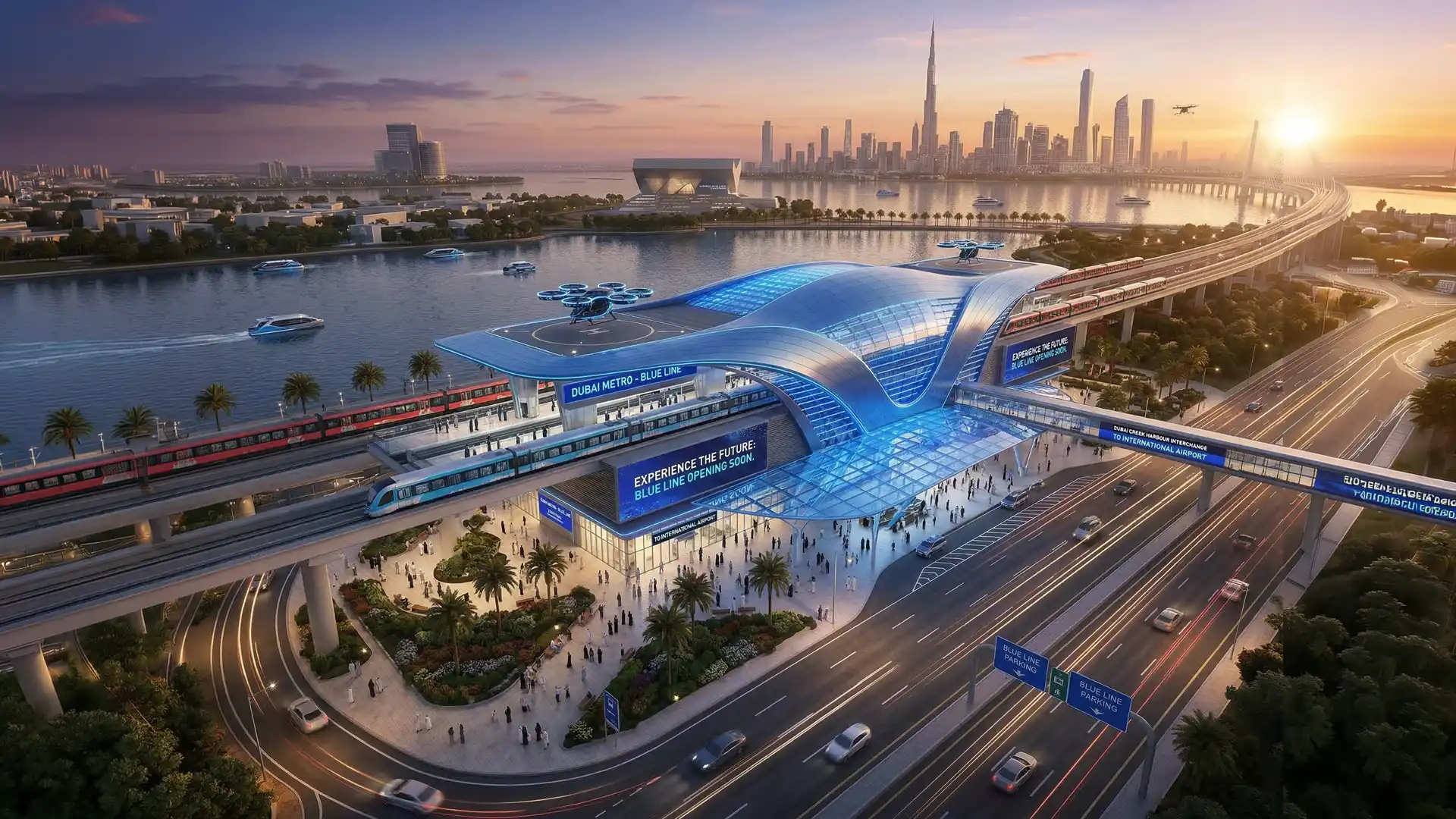
Dubai metro blue line property prices — the question every serious investor is asking in 2026, and the one question that every existing article fails to answer properly. Time Out Dubai tells you the stations. Khaleej Times shows you the route map. LYM Real Estate tells you the general areas. Nobody has published what you actually need: a station-by-station price forecast, a current-vs-2029 comparison table, and the honest answer to whether the window is still open. It is. But not for much longer.
Dubai metro blue line property prices are already rising — with the line still three years from opening. Understanding dubai metro blue line property prices now, before 2029, is the entire investment thesis. The RTA has officially confirmed an expected 25% uplift near stations. Academic City studio rents have risen 43% since the November 2023 announcement. Silicon Oasis and International City rents are up over 20% in 2025. The line opens 9 September 2029. Construction is at 10% — the optimal buy window based on historical Red Line data is right now, 3–4 years before opening. The best-value entry points: Silicon Oasis (1BR from AED 700K), International City (studios from AED 300K), and Mirdif (1BR from AED 900K). Dubai Creek Harbour is the prestige play — home to the world's highest metro station at 74 metres.
The Price Uplift Is Already Happening — The Data Right Now
Every article about the Dubai Metro Blue Line talks about what will happen in 2029. But dubai metro blue line property prices data shows the uplift started in November 2023 — the moment Sheikh Mohammed approved the project. Dubai metro blue line property prices are not a 2029 story — and anyone still treating them that way is already late. They are a right-now story.
Looking at dubai metro blue line property prices area by area, Academic City is the clearest example. Before the announcement, studio apartments rented for AED 42,000 per year. By early 2026, the same studios are at AED 60,000. That is a 43% increase in rental value in 26 months — driven purely by the anticipation of metro access, not by any change in the physical community. The line has not even reached 15% construction.
Dubai metro blue line property prices in Silicon Oasis are following the same pattern. A community of 88,000+ residents that relied entirely on road transport for its entire history, DSO saw rents rise over 20% in 2025. Dubai metro blue line property prices in Silicon Oasis are moving faster than any comparable community on the Red Line did at this stage. In International City, the most price-sensitive large residential community in Dubai, affordable apartment rents rose over 20% in 2025 — outpacing growth in prime areas like Downtown and Marina.
What the Red Line Taught Us — The Blueprint for Blue Line Returns
The Red Line opened in September 2009. The pattern it created for surrounding property values is the most powerful data set available for understanding what dubai metro blue line property prices will do between now and 2029.
According to CBRE's Dubai Metro Report, properties within a 15-minute walk of Red Line stations appreciated 43.8% on average, outpacing the wider Dubai market by 2.6%. JBR recorded 40.5% price growth. Dubai Marina recorded 35.9%. Discovery Gardens — previously considered a peripheral community — saw rental demand surge as connectivity transformed it from a car-dependent suburb into a metro-accessible neighbourhood.
| Area | Metro Line | Pre-Opening Price | Post-Opening Uplift | Blue Line Equivalent |
|---|---|---|---|---|
| Dubai Marina | Red Line | AED 850/sqft (2009) | +35.9% | Dubai Creek Harbour |
| JBR | Red Line | AED 900/sqft (2009) | +40.5% | Dubai Festival City |
| Discovery Gardens | Red Line | AED 400/sqft (2009) | +High | International City |
| Barsha Heights | Red Line | AED 500/sqft (2010) | +Significant | Silicon Oasis |
| 15-min walk avg | Red Line | Various | +43.8% avg | All Blue Line zones |
When analysts compare dubai metro blue line property prices against Red Line history, the pattern is identical — but the magnitude is larger. The critical difference between the Red Line precedent and the Blue Line opportunity: the Red Line connected already-established communities. The Blue Line connects underserved growth communities — areas with existing large populations that have never had metro access. The uplift potential in those communities is significantly higher because the starting point is lower and the transformation is more dramatic.
"Properties located within a 10-minute walk of planned stations attract heightened interest even in the short term, as buyers look to capitalise on future investment potential." This is exactly what is driving dubai metro blue line property prices in 2026 — anticipation, not arrival.
— Haider Tuaima, Managing Director & Head of Real Estate Research, ValuStrat, 2025The Complete Dubai Metro Blue Line Route — All 14 Stations & Property Zones
The Blue Line runs 30km across two branches. Dubai metro blue line property prices are already rising in every community along this corridor — and the line is only 10% built. These are the areas and stations that matter most. Branch 1 runs from Creek (Green Line interchange) through Festival City, Creek Harbour, Ras Al Khor, and International City to Silicon Oasis and Academic City. Branch 2 runs from Centrepoint (Red Line interchange) through Mirdif and Al Warqa to join Branch 1 at International City 1.
The Blue Line connects the Green Line (at Creek/Al Jaddaf) and the Red Line (at Centrepoint/Rashidiya) through 14 new stations across eastern and north-eastern Dubai. Branch 1 runs 10 stations from Creek to Academic City. Branch 2 runs 4 stations from Centrepoint to International City 1, where both branches converge. Click any pin for property price forecast and investment notes. All percentage figures represent Urban Terrace's projected property price uplift by 2029. Dubai metro blue line property prices are mapped per area based on RTA projections and CBRE historical analysis.
All 14 Stations Explained — Location, Significance, and Property Upside
This is the breakdown every buyer needs. Not just the station names — the property context around each one, and why it matters to your investment.
Creek — Green Line Interchange (Al Jaddaf)
The western anchor of the Blue Line. Connects to the existing Green Line at Al Jaddaf. Dubai Creek Harbour's master plan extends from this point. Al Jaddaf itself is home to the Palazzo Versace Dubai and several established residential projects. Already well-connected — the Blue Line makes it a true network hub.
Dubai Festival City
One of Dubai's most established master-planned communities — a city within a city including Festival City Mall, Ikea, and a large residential population. The station formally integrates this community into the metro network for the first time. Expect 15–20% price uplift in residential Festival City units over 2026–2029.
Dubai Creek Harbour — Emaar Properties Station ★
The standout station of the entire Blue Line. At 74 metres, this is the world's highest metro station — designed by Skidmore, Owings & Merrill, the firm behind the Burj Khalifa. Dubai Creek Harbour is Emaar's most ambitious master plan — a full city with its own skyline, marina, and retail core currently under construction. The global prestige of this station will drive international buyer attention to Creek Harbour property in a way no marketing campaign could replicate.
Ras Al Khor Industrial Area
The wildcard station. Industrial zones are not typically considered residential investment territory — but the precedent of industrial land transitioning to mixed-use following metro connectivity is well-established globally. Emaar has confirmed interest in a land deal in Ras Al Khor. This station has option value — not core residential today, but potentially significant rezoning upside by 2029.
International City 1 — Dubai Metro Blue Line Property Prices: Highest Upside Zone ★
At 44,000 square metres, this will be the world's largest underground metro station. The interchange between both Blue Line branches. International City is Dubai's most densely populated affordable residential community — an area of enormous rental demand that has never had metro access. The combination of the world's largest underground station + the highest-volume affordable community in Dubai = the highest percentage uplift potential on the entire line. Dubai metro blue line property prices at International City will see the most dramatic transformation of any station area.
International City 2 & 3
Additional stations serving the extended International City cluster. Each station creates a walkable catchment that will attract new residential investment in a community where entry-level apartments are still some of the most affordable in Dubai — studios from AED 280,000–350,000.
Dubai Silicon Oasis — Dubai Metro Blue Line Property Prices in Tech City
A dedicated technology park and residential community of 88,000+ residents. DSO has been one of the most undervalued communities in Dubai purely because of its road-dependent isolation. The Blue Line changes that equation completely. A professional in DIFC or Business Bay will be able to reach DSO by metro in 25–30 minutes — making it a viable alternative to JLT apartments at 40–50% premium. That gap will close.
Dubai Academic City — Dubai Metro Blue Line Property Prices and Rental Demand
27 universities. 27,500+ students. A community built entirely around education that has relied on buses and private cars for its entire history. The Blue Line transforms Academic City into a metro-connected destination for students, lecturers, and support staff. The rental market here will structurally transform. Dubai metro blue line property prices in Academic City are being driven by 27,500 students who currently have no rail option — expect sustained rent growth and increasing investor demand as the opening date approaches.
Centrepoint — Red Line Interchange
The eastern terminus of the existing Red Line at Rashidiya. The Blue Line adds a second branch here, opening a direct connection from Mirdif and Al Warqa into the full metro network. Centrepoint is already the most connected eastern node — the Blue Line makes it a true multiline interchange for the first time.
Mirdif
Dubai's largest established family-oriented suburb. Mirdif has strong organic demand, Mirdif City Centre mall, and a settled community — but no metro access has kept it relatively undervalued versus comparable areas. The Blue Line station changes that fundamentally. Properties within 500m of the station are the most direct beneficiary.
Al Warqa
A predominantly Emirati residential area connecting Mirdif to the International City interchange. Currently very affordable — villas and apartments at significantly below comparable areas. The Blue Line provides a direct rail connection to the wider city for the first time in Al Warqa's history.
Dubai Metro Blue Line — Station Property Price Forecast
Current 2026 entry prices and the projected 2029 uplift for every key station area. This is the only dubai metro blue line property prices station-by-station forecast table published anywhere. Use it to identify your entry point before the window closes.
| Station Area | 1BR Entry Price 2026 | Forecast Uplift by 2029 | Best For |
|---|---|---|---|
| Dubai Creek Harbour World's Highest Station ★ 74m |
AED 1.6M – 2.2M | +20–30% | Prestige long-play |
| Dubai Festival City | AED 1.2M – 1.7M | +15–20% | Established community |
| International City 1 World's Largest Underground ★ 44,000m² |
AED 500K – 750K | +25–35% | Highest % upside |
| International City 2 & 3 | AED 450K – 650K | +20–28% | Best value entry |
| Dubai Silicon Oasis 88,000+ residents gaining first metro access |
AED 700K – 950K | +20–28% | Commuter arbitrage |
| Dubai Academic City 27 universities · 27,500 students |
AED 650K – 900K | +25–35% | High rental yield |
| Mirdif | AED 900K – 1.3M | +18–25% | Family community |
| Al Warqa | AED 750K – 1.1M | +15–22% | Undervalued area |
| Ras Al Khor | Land play | Rezoning TBD | Speculative / land |
The Blue Line has two world-record stations. Dubai Creek Harbour (Emaar Properties Station) will be the world's highest metro station at 74 metres — the global landmark will attract international buyer attention to Creek Harbour property directly. International City 1 will be the world's largest underground metro station at 44,000 square metres — a facility designed for 350,000 passengers per day in one of Dubai's most affordable communities.
In property investment, global landmark status is a multiplier. The Burj Khalifa effect on Downtown Dubai values is documented — an iconic building directly lifts the valuations of everything within walking distance. The Creek Harbour station will create the same effect. Entry now, at pre-construction prices, is the play.
The Investment Window — Why March 2026 Is the Optimal Entry Point
The Red Line's property impact followed a clear three-phase pattern. Applied to dubai metro blue line property prices, it tells you precisely where in the cycle we are today. Understanding it tells you exactly where we are in the Blue Line cycle right now.
| Phase | Timing | What Happens | Red Line Equivalent | Blue Line Status |
|---|---|---|---|---|
| Phase 1 — Announcement | 0–12 months post-announcement | First wave of smart money moves in. Prices begin to nudge. Most buyers still unaware. | Nov 2007 – Nov 2008 | Passed — Nov 2023 |
| Phase 2 — Construction Visible | 12–36 months post-start | Construction sites visible. Media coverage increases. Second wave of buyers enters. Best value-to-risk ratio. Rents start rising strongly. | 2008–2010 | WE ARE HERE — Mar 2026 |
| Phase 3 — Opening Imminent | 12 months before opening | Prices have moved significantly. Entry cost much higher. Rental yields compressing as capital values rise. | 2008–2009 | 2028 onwards |
| Phase 4 — Post-Opening | Opening + 6–24 months | Prices peak. Rental demand surges. Late buyers pay full price. Best for renters, not investors. | 2009–2011 | September 2029+ |
Phase 2 is the sweet spot for dubai metro blue line property prices. Construction is visible enough to eliminate project risk — the AED 18 billion has been committed, 12 sites are active, 500+ engineers are deployed. But prices have not yet fully priced in the 2029 uplift. The average buyer is still reading about station locations and route maps, not buying property. That gap is the window. The buyers who understand dubai metro blue line property prices today will be the case studies cited in 2030.
"Infrastructure always whispers before prices speak out loud. Entering before full operational maturity defines long-term returns."
— Danube Properties Market Commentary, February 2026Construction Update — March 2026: 10% Complete, On Track for 30% by End-Year
The RTA's most recent update, delivered by Director General Mattar Al Tayer, confirmed that Dubai Metro Blue Line construction reached 10% completion in November 2025 — achieved in just five months from the June 2025 groundbreaking. The project is on track for 30% completion by end of 2026.
Current active works: 500+ engineers and experts, 3,000 workers across 12 active construction sites. 11 traffic diversions have been implemented with 10+ additional planned as station construction progresses across the corridor. The 30km route spans 14.5km elevated and 15.5km underground. The underground sections — particularly the International City 1 mega-station — are the most complex and most advanced in terms of engineering specification.
For buyers tracking dubai metro blue line property prices, this construction milestone is significant. It eliminates the risk that existed at announcement phase — dubai metro blue line property prices in active construction corridors historically accelerate once groundworks become visible that existed at announcement phase — the project is manifestly real, government-funded, and on schedule. For those who track Dubai real estate's resilience through global volatility and the capital inflows being accelerated by global trade tensions, the Blue Line is the structural infrastructure story underpinning the next decade of Dubai property appreciation. See also our analysis of whether Dubai property prices are coming down — spoiler: the Blue Line is one of the key reasons they are not.
8 Direct Questions Answered — Dubai Metro Blue Line Property Prices
The RTA has officially confirmed that dubai metro blue line property prices near stations are projected to rise by up to 25%. Independent analysis of dubai metro blue line property prices by CBRE supports this with Red Line historical data. This is supported by CBRE data showing Red Line properties within a 15-minute walk appreciated 43.8% on average. Academic City studio rents have already risen 43% since the November 2023 announcement. The uplift is not uniform — International City and Academic City face the biggest transformation (from road-dependent to metro-connected) and are projected to see the highest percentage gains of 25–35%. Creek Harbour and Festival City have higher starting prices and will see premium absolute gains.
Source: RTA Director General Mattar Al Tayer statement November 2025, CBRE Dubai Metro Report, Betterhomes / Property Monitor data 2025–2026The highest upside areas for dubai metro blue line property prices — ranked by projected percentage gain — are: International City (25–35% projected uplift, most affordable entry from AED 280K studios, world's largest underground station), Dubai Academic City (25–35% uplift, rent already up 43%, 27,500 students creating structural rental demand), Dubai Silicon Oasis (20–28% uplift, 88,000+ residents gaining first metro access, significant commuter arbitrage vs JLT), and Dubai Creek Harbour (20–30% uplift, world's highest station, Emaar master plan, prestige play).
Ras Al Khor is the speculative wildcard — industrial rezoning potential and Emaar's confirmed land interest could create significant upside for land investors, though timing is less certain than the residential plays.
Source: Gulf News property analysis 2025, ValuStrat Haider Tuaima commentary, RTA official projectionsThe Dubai Metro Blue Line opening date is 9 September 2029 — the 20th anniversary of the Dubai Metro (first opened 9.9.2009). Construction began June 2025 after Sheikh Mohammed laid the foundation stone. As of November 2025, 10% of construction is complete — achieved in five months. The RTA confirms the project is on track for 30% completion by end of 2026.
The AED 18 billion project involves 500+ engineers and 3,000 workers across 12 active sites. The total investment generates projected economic benefits of AED 56.5 billion by 2040 through time savings, fuel savings, and reduced accident fatalities. The opening date is fixed as a milestone — it marks Dubai Metro's 20th anniversary and carries significant national symbolism.
Source: RTA Director General Mattar Al Tayer official statement, ARN News, Dubai Eye November 2025Branch 1 (10 stations, Creek → Academic City): Creek Interchange (Green Line), Dubai Festival City, Dubai Creek Harbour (Emaar Station — world's highest at 74m), Ras Al Khor Industrial Area, International City 1 (world's largest underground station, 44,000m²), International City 2, International City 3, Dubai Silicon Oasis, and Dubai Academic City.
Branch 2 (4 stations, Centrepoint → International City 1): Centrepoint (Red Line Interchange), Al Warqa, Mirdif, International City 1 (joins Branch 1). Total: 9 elevated stations, 5 underground stations. For dubai metro blue line property prices, the underground stations carry the highest uplift potential. 14.5km elevated, 15.5km underground. Capacity: 320,000–350,000 passengers per day.
Source: RTA official Blue Line announcement, Khaleej Times station breakdown December 2025, Wikipedia Blue Line Dubai MetroMarch 2026 is the optimal window to buy based on dubai metro blue line property prices data and historical Red Line patterns. Construction is at 10% — late enough that project risk is zero (AED 18B committed, active sites, government-backed), early enough that current prices do not fully reflect 2029 uplift. Based on the Red Line pattern, the best returns went to buyers who entered 3–4 years before opening. The Blue Line opens September 2029 — placing today in precisely that window.
Best value entry points by risk/return profile: International City (studios from AED 280K — highest % upside, most affordable), Silicon Oasis (1BR from AED 700K — best commuter arbitrage play), Academic City (1BR from AED 650K — highest rental yield from student demand), Dubai Creek Harbour (1BR from AED 1.6M — prestige play, world-record station, Emaar backing).
Source: Urban Terrace March 2026 market data, Sands of Wealth property forecasts 2026, DLRC/Pearlshire infrastructure investment analysisCBRE's Dubai Metro Report shows properties within a 15-minute walk of Red Line stations appreciated 43.8% on average. Applied to dubai metro blue line property prices today, that same methodology projects between 25% and 43% uplift by 2029, outpacing wider Dubai by 2.6%. JBR recorded 40.5% growth. Dubai Marina: 35.9%. Discovery Gardens saw rental demand surge as connectivity transformed it from peripheral suburb to metro-accessible community. Vacancy rates near stations were 30% lower during market corrections.
The Blue Line has stronger upside than the Red Line for one key reason: it connects communities that were completely road-dependent — a larger transformation than the Red Line, which connected already-developing areas. Silicon Oasis, Academic City, and International City have larger existing populations than the Red Line corridor communities had in 2009, and a stronger existing rental demand base that metro access will immediately activate.
Source: CBRE Dubai Metro Report 2023, Danube Properties Blue Line analysis February 2026Dubai metro blue line property prices at Creek Harbour carry a world-record premium. The Dubai Creek Harbour station — officially named the Emaar Properties Station — will be the world's highest metro station at 74 metres, with 3 levels. It was designed by Skidmore, Owings & Merrill (SOM), the firm that designed the Burj Khalifa, the Willis Tower (Chicago), and the One World Trade Center (New York). The station's global landmark status positions Creek Harbour as an international investment destination in the same way the Burj Khalifa positioned Downtown Dubai.
Dubai Creek Harbour itself is Emaar's most ambitious project — a master-planned community with its own distinctive tower (surpassing the Burj Khalifa in ambition), waterfront promenade, and retail core. A property bought near the world's highest metro station, in Emaar's flagship development, before either is complete — is one of the clearest examples of buying into a compounding narrative at the right time.
Source: Sheikh Mohammed official statement June 2025, Khaleej Times station design reveal December 2025, SOM architectural announcementThe Blue Line connects to the Green Line at Creek Station (Al Jaddaf) and to the Red Line at Centrepoint Station (Rashidiya). This full network integration is a key driver of dubai metro blue line property prices — it makes every station community accessible to the entire city. International City 1 is the underground interchange between both Blue Line branches — at 44,000 square metres it is the world's largest underground metro station. The Blue Line will also integrate with the future Etihad Rail network.
When complete, Dubai's total rail network will reach 131km with 78 stations and 168 trains. A resident of Silicon Oasis or Academic City — currently facing 45–60 minute road journeys to central Dubai — will have a 25-minute metro ride to DXB airport and direct connections across the entire network. For context: the Blue Line will connect residents in International City and Academic City to Downtown Dubai, DIFC, Business Bay, and Dubai Marina — all without a car. That connectivity transformation is priced at 25–35% by 2029. We think that estimate is conservative.
Source: Wikipedia Blue Line Dubai Metro (updated March 2026), RTA official network expansion data, K&S Properties connectivity analysisDubai metro blue line property prices are not a 2029 story — and anyone still treating them that way is already late. The data shows that Academic City rents have risen 43%, Silicon Oasis and International City are up 20%+ in 2025 alone — and the line is only 10% built. The RTA has officially put a 25% number on it. CBRE's Red Line data suggests the real number is closer to 40%. The world's highest metro station is being built in Creek Harbour by the Burj Khalifa architects. The world's largest underground metro station is being built in International City — in a community where you can still buy a studio for AED 280,000.
The investment window is Phase 2 of a 4-phase cycle. Phase 1 (announcement, Nov 2023) has passed. Phase 3 (pre-opening premium) begins in 2028. Between now and early 2028 is the window where construction risk is zero and price is not fully loaded. That is right now. The best entry points are International City for volume and yield, Silicon Oasis for commuter arbitrage, Academic City for structural rental demand, and Creek Harbour for the prestige long play. The Blue Line opens 9.9.2029. Make your move before the prices do. Dubai metro blue line property prices in 2026 are the equivalent of buying near the Red Line in 2007 — before the network transformed eastern Dubai forever.
Buy near the Blue Line before 2029 prices it in fully.