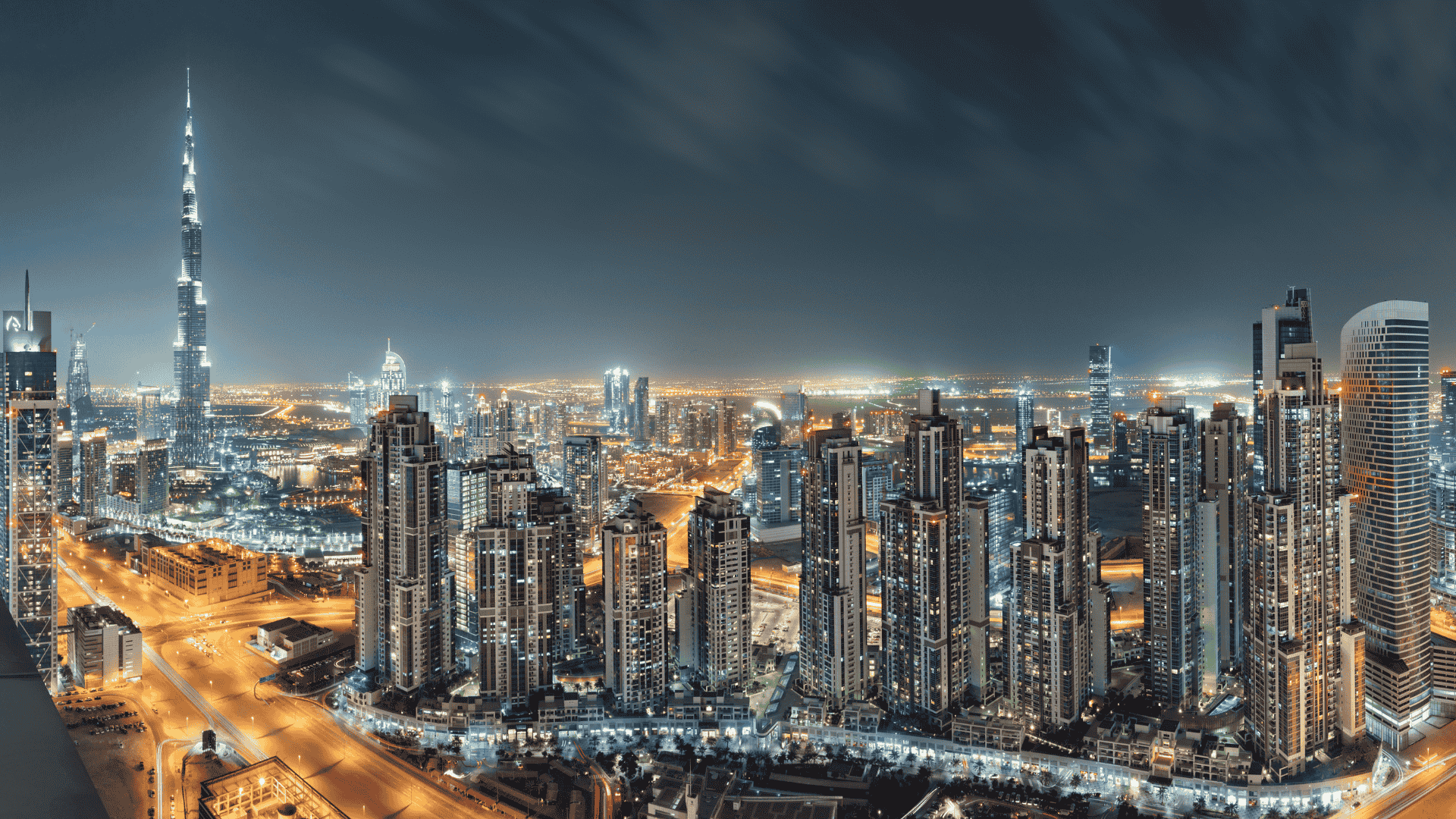
The relationship between Dubai real estate and global tensions is one of the most misunderstood dynamics in international property investment. As trade wars escalate, the Russia-Ukraine conflict drags into its fourth year, and the Middle East fractures at unpredictable intervals, the instinctive assumption is that Dubai real estate should suffer. The data says the opposite.
Open any newspaper in 2026 and the headlines are alarming. US-China tariffs are at levels not seen since the 1930s. The Russia-Ukraine war has no end in sight. Iran and Israel remain in a cold war that turns hot at unpredictable intervals. Global debt has crossed $315 trillion. Central banks, having over-stimulated their economies, are now fighting inflation or recession — sometimes both.
It is reasonable to ask: with all of this, what happens to Dubai property? Should you be buying, holding, or getting out?
The short answer — the one that frustrates people who want a clean narrative — is that Dubai real estate has repeatedly shown it performs best precisely when the rest of the world is performing worst. The reasons are structural, not lucky. Understanding them is the difference between panicking out of a good position and doubling down on one.
Why Global Tensions Are Dubai Real Estate's Biggest Tailwind
Dubai is not the world's financial capital. It is not the world's largest economy. What it is, structurally, is the world's most useful neutral ground — and in an era of geopolitical polarisation, neutrality is priceless. This is the core reason why global tensions and Dubai real estate move in the same direction.
When Russia invaded Ukraine in February 2022, Western nations froze Russian assets, cut off SWIFT access, and effectively locked Russian capital out of Europe. Where did it go? A measurable portion went to Dubai, where the UAE had pointedly abstained from the UN vote condemning Russia. Not because Dubai was pro-Russia — but because the UAE government made a strategic decision to remain accessible to all sides. That decision drove a 19% rise in Dubai property prices during a year most markets were in retreat.
The same pattern played out in 2023 and 2024. As the Israel-Gaza conflict widened and Israeli and Lebanese capital looked for a safe domicile, Dubai absorbed it. As Chinese HNW individuals accelerated international diversification in response to US-China decoupling, Dubai's well-connected Chinese community and direct flight links made it an obvious landing pad. As European tax regimes tightened and cost-of-living crises eroded quality of life from London to Berlin, professionals and retirees chose a zero-income-tax jurisdiction with better weather and lower prices per square metre.
"Every time the world becomes more dangerous, more fractured, or more unpredictable, Dubai real estate receives a new wave of capital from people who have decided that stability is worth paying for."
— Urban Terrace Research, March 2026This is not speculation. It is the documented flow of capital, visible in Dubai Land Department transaction records, in Emirates Airline passenger growth, and in UAE Golden Visa issuance numbers. In 2025, the UAE issued more than 90,000 Golden Visas. That is 90,000 households that have formally declared Dubai their primary or secondary home — and most of them bought property. Global tensions and Dubai real estate investment are, counterintuitively, positively correlated.
Dubai Real Estate & Global Tensions: The Full Risk Map
Being honest about an investment means being honest about the risks too. Not every global scenario is a Dubai real estate tailwind. Here is the current risk landscape as we see it — the scenarios that help, the scenarios that hurt, and the scenarios to watch.
| Tension / Scenario | Impact on Dubai Real Estate | Direction | Risk Level |
|---|---|---|---|
| US-China trade war escalation | Increases Chinese capital outflow to Dubai. Jebel Ali Free Zone becomes more strategic as a re-export hub. Positive inflow driver for Dubai real estate. | ↑ Positive | Low Risk |
| Russia-Ukraine war continuation | Russian and Ukrainian capital continues to flow to Dubai as the most accessible neutral jurisdiction. Sustained demand from both sides. | ↑ Positive | Low Risk |
| Iran-Israel direct military conflict | Short-term sentiment hit possible on Dubai real estate. UAE has air defence (Patriot, THAAD). Diplomatic neutrality maintained. Medium-term, conflict displaces capital to Dubai. | → Neutral / Short dip | Watch |
| Global recession (US + EU) | Western buyer demand softens. Asian, GCC, and BRICS-country demand partially offsets. Dubai real estate price growth slows but structural floor remains. | → Slowed growth | Watch |
| USD peg crisis (AED devaluation) | Extremely low probability. The AED-USD peg has held since 1997 through Gulf War, 9/11, 2008 GFC, and COVID. UAE has $700B+ in sovereign wealth to defend it. | ↓ Negative if occurred | Very Low |
| Oil price collapse below $40/barrel | Dubai's economy is now only ~2% oil-dependent. Trade, tourism, and finance drive Dubai GDP. Moderate negative effect on Dubai property but not existential. | ↓ Mild negative | Watch |
| UAE political instability | No credible current scenario. UAE is a federated monarchy with institutional stability. No elections, no opposition movements, no succession risk in near term. | ↑ Stable | Very Low |
Dubai Real Estate & Global Tensions: 8 Questions Every Investor Is Asking
These are the questions we receive daily from investors, relocating families, and concerned property owners navigating the intersection of global tensions and Dubai real estate decisions. Each answer is direct — no jargon, no hedging.
Yes — with a historically strong track record. Dubai real estate has outperformed during every major geopolitical crisis of the past decade. Its political neutrality, zero income tax, 100% freehold ownership for foreigners, and position as a logistics and financial hub between East and West make it a capital safe haven when global tensions rise. During the 2022 Russia-Ukraine crisis, Dubai recorded its highest-ever transaction volumes. During the 2023–2024 Middle East conflict, prices rose — not fell.
Source basis: DLD transaction data 2022–2025, CBRE Dubai Market ReportsDubai property prices are partially decoupled from Western recession cycles. Dubai's economy is driven by tourism, trade, logistics, and inbound capital — not domestic manufacturing or consumption. In 2008, Dubai did see a price correction. However, since 2020 the market structure has fundamentally changed: population is growing by ~100,000 people per year, land supply in prime locations is capped, and global HNW migration creates structural demand that buffers against Western-driven dips. Most credible forecasts project 5–8% annual price growth through 2028 even in recession scenarios for Europe and the US.
Source basis: Knight Frank Global Prime Forecast, JLL Dubai 2026 OutlookThe US-China trade war is likely to benefit Dubai real estate. As Chinese manufacturers seek neutral re-export hubs, Jebel Ali Free Zone gains strategic importance — driving business investment into Dubai. More directly, Chinese HNW individuals historically accelerate outbound investment during periods of US-China tension. Dubai — with direct Air China and Emirates connectivity, a Mandarin-friendly business environment, and zero capital gains tax — consistently ranks in the top three destinations for Chinese capital diversification. We have seen a measurable increase in Chinese buyer enquiries since tariff escalation resumed in early 2026.
Source basis: Juwai IQI Chinese Buyer Index Q1 2026, Emirates NBD Trade DataCounterintuitively, regional Middle East conflict increases demand for Dubai real estate. Dubai functions as the financial and residential safe haven for capital fleeing Lebanon, Iran, Egypt, Palestine, and other economies under stress. The UAE normalised relations with Israel in 2020 (Abraham Accords) and simultaneously maintains economic ties with Iran — this dual positioning makes Dubai genuinely accessible to all sides of regional global tensions. During the 2023 Gaza conflict and 2024 Iran-Israel direct engagement, Dubai saw a measurable inflow of Levantine and Gulf capital. There is no credible security threat to Dubai from the current conflict.
Source basis: Abraham Accords investment data, CBRE Beirut capital flow analysisBased on current fundamentals, yes — with appropriate due diligence. Dubai's population is growing at ~100,000 per year. Off-plan prices in active communities are 20–40% below secondary market levels for equivalent units, creating a built-in appreciation buffer. The primary risk is developer delivery — mitigated by buying only from RERA-registered developers with escrow-protected construction funds. The larger risk, historically, has been waiting: those who delayed buying in 2020 citing COVID uncertainty missed a 60% price run by end-2022. The same logic applies now — global tensions and Dubai real estate are, for buyers, a window of opportunity.
Source basis: RERA Escrow registration data, DLD transaction records 2020–2025The UAE Golden Visa is a 10-year renewable residency available to property investors who purchase AED 2 million (approx. USD 545,000) or more in freehold property. In a world of increasing travel restrictions, passport tiering, and geopolitical fracturing, UAE residency provides a second-home base in a country with visa-free or visa-on-arrival access to 180+ nations, zero income tax, and a government positioned as a neutral international hub. As Western countries tighten immigration and introduce exit taxes for high earners, the Golden Visa becomes more valuable — not less. It is essentially optionality: you do not have to move to Dubai, but you have the legal right to if conditions at home deteriorate. For many investors tracking global tensions, Dubai real estate doubles as a personal insurance policy.
Source basis: UAE ICP Golden Visa issuance data 2025, Henley Passport Index 2026A global equity crash could have two opposing effects on Dubai real estate. HNW investors who suffer paper losses in equities may reduce discretionary real estate purchases — creating short-term softness, particularly in the luxury segment above AED 10M. However, a flight from volatile paper assets to hard assets historically benefits Dubai, which is denominated in AED — pegged to the USD and among the most stable store-of-value currencies globally. The historical precedent is clear: the March 2020 COVID equity crash saw Dubai prices dip briefly before surging over 60% by end-2022. Mid-market and off-plan segments tend to be more insulated than the ultra-luxury secondary market.
Source basis: DLD price index 2019–2025, Knight Frank Prime Residential IndexNo credible security analyst currently lists Dubai as a target or collateral risk. The UAE has maintained strict diplomatic neutrality — normalising relations with Israel in 2020 via the Abraham Accords while simultaneously maintaining functioning economic relations with Iran. The UAE is a member of neither NATO nor any regional military alliance. Its air defence infrastructure includes Patriot and THAAD batteries, and the UAE Air Force is among the most advanced in the region. The risk to Dubai real estate in a severe global tensions escalation scenario is sentiment-driven — not physical. And sentiment-driven dips in Dubai have historically reversed quickly.
Source basis: UAE Ministry of Foreign Affairs statements, IISS Military Balance 2025The global tensions of 2026 are not a reason to avoid Dubai real estate. For most investor profiles — particularly those seeking hard-asset stability, second-residency optionality, or a hedge against deteriorating conditions at home — they are a reason to look at Dubai real estate more seriously than ever. The structural drivers of the market (population growth, limited prime supply, global capital inflow, political neutrality, zero income tax) are all intact. The risks are real but manageable. The alternative — holding cash or paper assets in a fractured global economy — carries its own substantial risks. In the relationship between global tensions and Dubai real estate, history has consistently rewarded those who understood which direction the capital flows.
Thinking about Dubai property? Talk to us first.