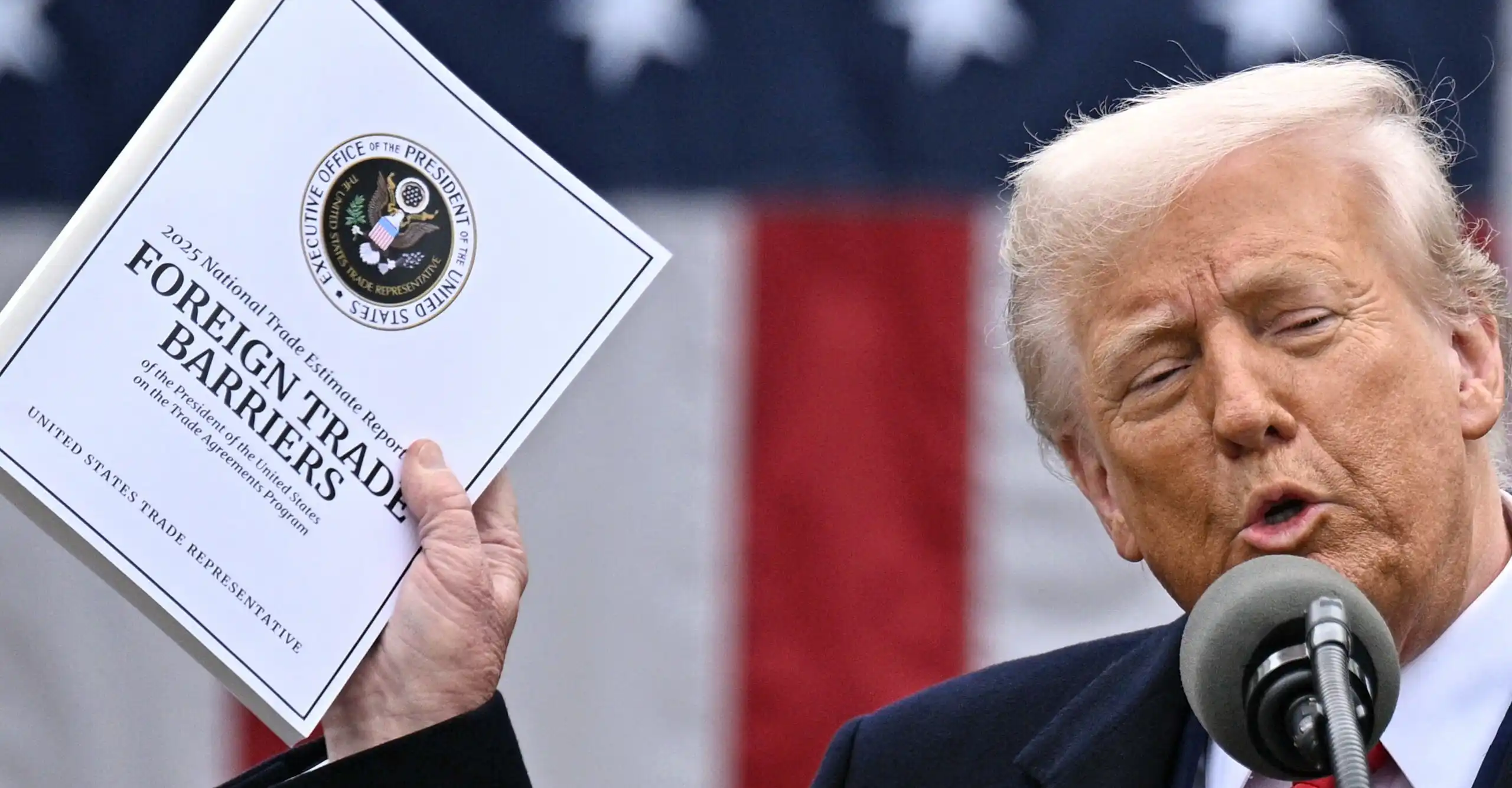
Trump tariffs and Dubai property have become the most searched combination in UAE real estate in 2026 — and for good reason. While every other major market absorbed the shock of a global trade war, Dubai's response was a 40% surge in investor interest and a 23% spike in monthly transactions. This is not a coincidence. Every major episode of global economic disruption since 2020 has sent capital flowing into Dubai. The trade war is simply the latest version of a pattern that has played out — and paid out — every single time.
Trump's tariffs have been a net positive for Dubai property investment. When the tariff announcement came, American and Chinese investor interest in Dubai real estate jumped 40% month-on-month, website traffic from those markets surged 60%, and Dubai's April 2025 transactions hit AED 46 billion — up 23% on the previous month. Dubai is not a casualty of the trade war. It is one of its primary beneficiaries, for structural reasons that have been in place since the city was designed as a global neutral capital hub.
The Headline vs The Data — What Bloomberg Missed
On 14 April 2025, Bloomberg published a headline describing Trump's tariffs as Dubai's "biggest threat since the pandemic." The concern around trump tariffs and Dubai property was understandable — oil prices had dipped below $65 a barrel, regional equity markets had moved, and there was genuine uncertainty in the air.
What the headline could not yet capture — because the data wasn't in yet — was what happened next. Betterhomes published its April data: investor interest from the US and China was up 40% month-on-month. Website traffic from those markets was up 60%. Transaction volumes hit AED 46 billion — 23% higher than March. The supposed threat had become a catalyst. Trump tariffs and Dubai property were moving in the same direction — upward.
This is the gap between how Dubai is covered internationally and what is actually happening on the ground. And it is the gap that every serious investor in 2026 needs to understand.
Why Dubai Wins When Every Other Market Is Under Pressure
Dubai is not resilient to trade wars by accident. It is resilient by design. Understanding how trump tariffs affect Dubai property starts with understanding what Dubai was built to be: a neutral, tax-efficient, globally accessible capital hub — and every one of those structural properties becomes more valuable when the alternative markets are under pressure.
Here is the mechanism. When trade war uncertainty hits a country — the US, China, the UK, Europe — investors in those countries do two things. They reduce exposure to domestic assets under pressure, and they search for somewhere to park capital that is outside the conflict zone. Dubai sits directly in that "outside the conflict zone" position, with a set of structural advantages no other major city can match simultaneously.
Zero Tax Environment
Dubai offers zero property tax, zero capital gains tax, and zero income tax on rental yields. When a US investor is worried about their domestic tax situation, or a British investor is navigating the tightened non-domicile rules, or a European investor is managing currency exposure, Dubai's tax position is an immediate and quantifiable advantage. You keep everything you earn.
USD-Pegged Currency
The UAE dirham has been pegged to the US dollar since 1997. For dollar-denominated investors — and for any investor in a country whose currency is weakening against the dollar — this is a direct benefit. When the dollar strengthens during trade war uncertainty, Dubai property priced in AED appreciates in value for foreign buyers holding weaker currencies. The peg is a structural hedge that most global markets cannot offer.
Political Neutrality
The UAE has trade agreements with both the US and China. It is not a party to the trade war. It takes no side. This neutrality is an enormous advantage in a polarised global economy — Dubai is genuinely one of the only major global cities where American capital and Chinese capital sit comfortably side by side, in the same buildings, in the same free zones, without political friction.
Golden Visa — The Residency Option
For investors who are not just parking capital but considering a physical relocation — because their home market is becoming less stable, less tax-efficient, or less attractive — the UAE's 10-year Golden Visa tied to a minimum AED 2 million property investment makes Dubai a full life option, not just an investment option. This is a dimension most global real estate markets simply cannot compete with.
"Every major episode of global economic disruption since 2020 — COVID, Ukraine, regional conflict, trade wars — has resulted in capital flowing into Dubai, not out of it."
— Urban Terrace Research Team, March 2026Trump Tariffs & Dubai Property — Who Is Buying and How Much
The impact of trump tariffs on Dubai property investment is visible across every major buyer nationality. The investor composition has shifted measurably since the tariff announcements. Here is what the data shows across the key buyer groups driving the 2026 market.
American investors — Up 40% month-on-month in April 2025 according to Betterhomes. The primary profile is HNWIs diversifying away from US assets, tech executives concerned about domestic market volatility, and business owners looking for a tax-efficient second base. The Golden Visa threshold of AED 2 million (approximately $545,000) is accessible for this buyer profile.
Chinese investors — Also up 40% in the same period. Chinese capital has been exiting to global property markets for years, but the trade war has accelerated it significantly. Jebel Ali Free Zone has emerged as a particular draw — Chinese companies rerouting supply chains through Dubai are bringing executive teams with them, driving residential demand in Marina, Downtown, and Dubai Hills.
European investors — British HNWIs accelerated Dubai purchases following the UK's tightened non-domicile tax rules. The volume of ultra-luxury purchases in Palm Jumeirah and Jumeirah Bay Island by British buyers has driven values in those communities upward through 2025 and into 2026.
Indian investors — The India-UAE CEPA trade agreement — which specifically reduces tariff and trade friction between the two countries — has made Dubai even more attractive for Indian HNWIs. Rupee strength relative to AED in certain periods has created buying windows that the Indian investor community has actively used.
Russian investors — Continuing to move wealth through Dubai given European sanctions and capital restrictions. Dubai's neutral position means Russian capital can still operate freely here in a way it cannot in London, Paris, or Zurich.
Tariff Rate by Country vs Dubai Property Investment — The Complete Picture
| Country / Region | US Tariff Rate | Impact on Domestic Market | Dubai Investment Response | Dubai Advantage |
|---|---|---|---|---|
| China | 145% | Severe export disruption. Manufacturing sector under pressure. Capital seeking exit routes. | +40% investor interest MoM. Jebel Ali rerouting. Executive relocations. | Maximum |
| European Union | 25% | Export sector hit. Euro under pressure. UK non-dom rule tightening accelerates outflow. | British UHNWI acceleration. Ultra-luxury segment driven upward. | High |
| India | 26% | IT and manufacturing sector exposed. INR volatility. HNWI diversification accelerates. | Sustained high-volume buying. CEPA agreement reduces bilateral friction further. | High |
| United States | N/A (origin) | Domestic uncertainty. Recession risk debated. Tech sector volatility. | +40% investor interest MoM. HNW diversification into UAE assets. | High |
| UAE / Dubai | 10% (baseline only) | Minimal direct export impact. No reciprocal duties on UAE imports. Construction costs unaffected. | Capital inflow beneficiary. Neutral ground for all parties. | Net Positive |
| Russia | Sanctions-based restrictions | European capital channels closed. Wealth seeking neutral jurisdictions. | Continued steady inflow. Dubai remains fully accessible to Russian capital. | High |
The Jebel Ali Free Zone Advantage Nobody Is Talking About
One of the most significant but under-reported consequences of the US-China trade war is what is happening at Jebel Ali Free Zone — the largest free zone in the world and one of the busiest ports globally. Asian companies, particularly Chinese manufacturers, are increasingly rerouting goods through JAFZA to reduce US tariff exposure. By processing or value-adding goods in a UAE free zone, companies can in some cases change the country of origin designation — a strategy that has driven a measurable uptick in corporate activity at Jebel Ali.
Corporate rerouting through JAFZA means more Asian companies are setting up UAE operational bases. That means more executive teams relocating to Dubai. Those executives need housing — and they need it in premium communities close to JAFZA's location in the south of Dubai, or in the established communities of Marina, Downtown, and Dubai Hills. Corporate demand of this type is structural, not speculative. It does not disappear when market sentiment shifts.
The UAE government has set an explicit target to double FDI inflows to $65 billion by 2031 — and free zone expansion is central to that strategy. Dubai's Real Estate Strategy 2033 aims to double the sector's contribution to GDP while targeting 33% homeownership. The infrastructure supporting residential demand is being built at a government level, not left to market forces alone.
Trump Tariffs & Dubai Property — 8 Direct Questions Answered
Trump's tariffs have been a net positive for Dubai property on three levels. First, they drove immediate investor interest — Betterhomes recorded a 40% surge in US and Chinese buyer enquiries in the month following the tariff announcement, with website traffic from those markets up 60%. Second, they did not affect Dubai's construction costs — the UAE faces no reciprocal duties on its own imports, so materials arrive tariff-free. Third, they have accelerated corporate rerouting through Jebel Ali Free Zone, bringing more companies and executives to Dubai.
Source basis: Betterhomes April 2025 Market Data, Arabian Business, DLD Transaction RecordsNo. US tariffs do not affect Dubai construction costs because the UAE faces no reciprocal duties — construction materials arrive tariff-free. Dubai property prices are driven by population growth, end-user demand from Golden Visa residents, and global capital inflows — none of which are negatively impacted by US trade policy. The National and Allegiance Real Estate's senior vice president both confirmed that Dubai's market is driven by fundamentals, not speculation, making it structurally resilient to tariff-related volatility.
If anything, a weaker US dollar — one likely outcome if tariffs trigger rate cuts from the Federal Reserve — would increase the purchasing power of non-dollar investors in the Dubai market, driving additional demand. The dirham peg means Dubai property effectively becomes cheaper in local currency terms for buyers in countries whose currencies strengthen against the dollar.
Source basis: The National / Allegiance Real Estate, Redlac Real Estate Currency Analysis, RERA Construction Cost IndexFour structural reasons. First, zero tax — no property tax, no capital gains tax, no income tax on rental yields. Second, the AED-USD peg — eliminates currency risk for dollar investors and creates a natural hedge for others. Third, political neutrality — Dubai has trade relationships with both the US and China and takes no side in the trade war, making it the only major global city where capital from all parties can coexist freely. Fourth, the Golden Visa — for investors considering relocation, not just investment, the 10-year residency tied to AED 2 million in property makes Dubai a complete life option.
Source basis: UAE Golden Visa Programme, Knight Frank Tax Comparison Report, UAE Central Bank Peg PolicyYes — and the data from every prior episode of global instability supports this. During COVID: Dubai property prices recovered and then appreciated 70% between 2021 and 2025. During the Ukraine war in 2022: capital inflows from Russia and Europe drove a price surge. During the regional conflict period of 2024: brief sentiment dips reversed within weeks and prices continued upward. The trade war of 2025–2026: US and Chinese investor interest up 40%, transactions up 23%.
Dubai's foreign direct investment doubled from 2020 to 2024. The government is targeting $65 billion in annual FDI by 2031. The UAE's fiscal budget has AED 28 billion allocated to infrastructure, education, and social development in 2025 alone. This is a market that is structurally set up to absorb global instability and emerge stronger from it.
Source basis: Arabian Business FDI Data, DLD Historical Price Index, CBRE Global Capital Markets ReportThe two sharpest new buyer groups triggered directly by tariff uncertainty are American and Chinese investors — both up 40% month-on-month according to Betterhomes. European buyers — particularly British investors affected by the tightened non-domicile tax regime — are accelerating purchases in the ultra-luxury segment. Indian HNWIs continue their sustained growth trajectory, bolstered by the India-UAE CEPA agreement. Russian investors continue moving wealth to Dubai given European capital restrictions.
Source basis: Betterhomes April 2025 Data, Knight Frank UHNW Buyer Analysis, Arabian Business Investor Nationality ReportJebel Ali Free Zone has emerged as a strategic hub for companies seeking to mitigate US tariff exposure. Asian companies — particularly Chinese manufacturers — are rerouting goods through JAFZA to access markets with lower or zero tariff exposure. This drives corporate setup in Dubai free zones, which drives executive relocations, which drives residential property demand in premium communities. The UAE government plans to double FDI inflows to $65 billion by 2031, with free zone expansion central to that strategy — meaning this trend has strong institutional support behind it.
Source basis: Arabian Business JAFZA Report, UAE Ministry of Economy FDI Target Data, Cushman & Wakefield Free Zone AnalysisThe UAE is forecast to grow at 4.6% in 2026 according to the IMF — the highest in the GCC, outpacing Saudi Arabia, Qatar, and Oman. While non-oil GCC growth is expected to slow to 3.4%, the UAE maintains clear regional leadership. Oil production is expected to hit 3.27 million barrels per day by 2026. ADNOC is targeting 5 million barrels per day by 2027. Dubai welcomed 19 million tourists in 2024. The UAE's population has reached 12 million nationwide, with 4 million in Dubai alone.
Source basis: IMF World Economic Outlook March 2026, ADNOC Production Forecast, Dubai Tourism Annual Report 2024The trade war uncertainty is one of the strongest structural arguments for Dubai property right now — not a reason to avoid it. Every major period of global economic disruption since 2020 has driven capital into Dubai. The buyers who moved during COVID, Ukraine, and regional conflict uncertainty all achieved significant appreciation. The pattern is consistent and the mechanism is clear: instability elsewhere increases Dubai's relative attractiveness as a neutral, tax-free, stable destination.
The one nuance worth noting: the specific segment you buy in matters. Villas and prime waterfront are the segments that most directly benefit from the UHNW capital inflows tariff uncertainty drives. Mid-market apartments in oversupplied communities are a different story — that's where you want to be more selective. For a conversation about exactly which segment fits your situation, our advisory team is available on WhatsApp below.
Source basis: DLD Historical Price Index 2020–2026, Knight Frank Cycle Analysis, Urban Terrace Advisory DataTrump tariffs and Dubai property are moving in the same direction — and the data has been consistent from the moment the first tariff announcement landed. A 40% surge in US and Chinese investor interest. A 23% spike in monthly transactions. Corporate rerouting through Jebel Ali. British UHNWI acceleration in ultra-luxury. Indian and Russian capital continuing to flow. The UAE growing at 4.6% — fastest in the GCC — while the countries caught in the trade war slow down.
Dubai was designed for exactly this scenario: a neutral, tax-free, dollar-pegged, politically stable hub that becomes more attractive every time the alternative markets become less so. The headlines calling it a threat were written before the data came in. The data tells a very different story. Position accordingly.
Global uncertainty is moving capital to Dubai. Make sure yours moves first.