Urban Terrace Market Intelligence · April 2026
Dubai's Dh34 Billion Underground
Metro Line Is Here.
Every Resident and Investor Needs to Read This.
Dubai Metro Gold Line is the biggest public transport announcement in the emirate's history — 42km, 18 stations, 40 metres underground, opening 2032. Here is everything you need to know about the route, the areas it serves, and what it means for your property.
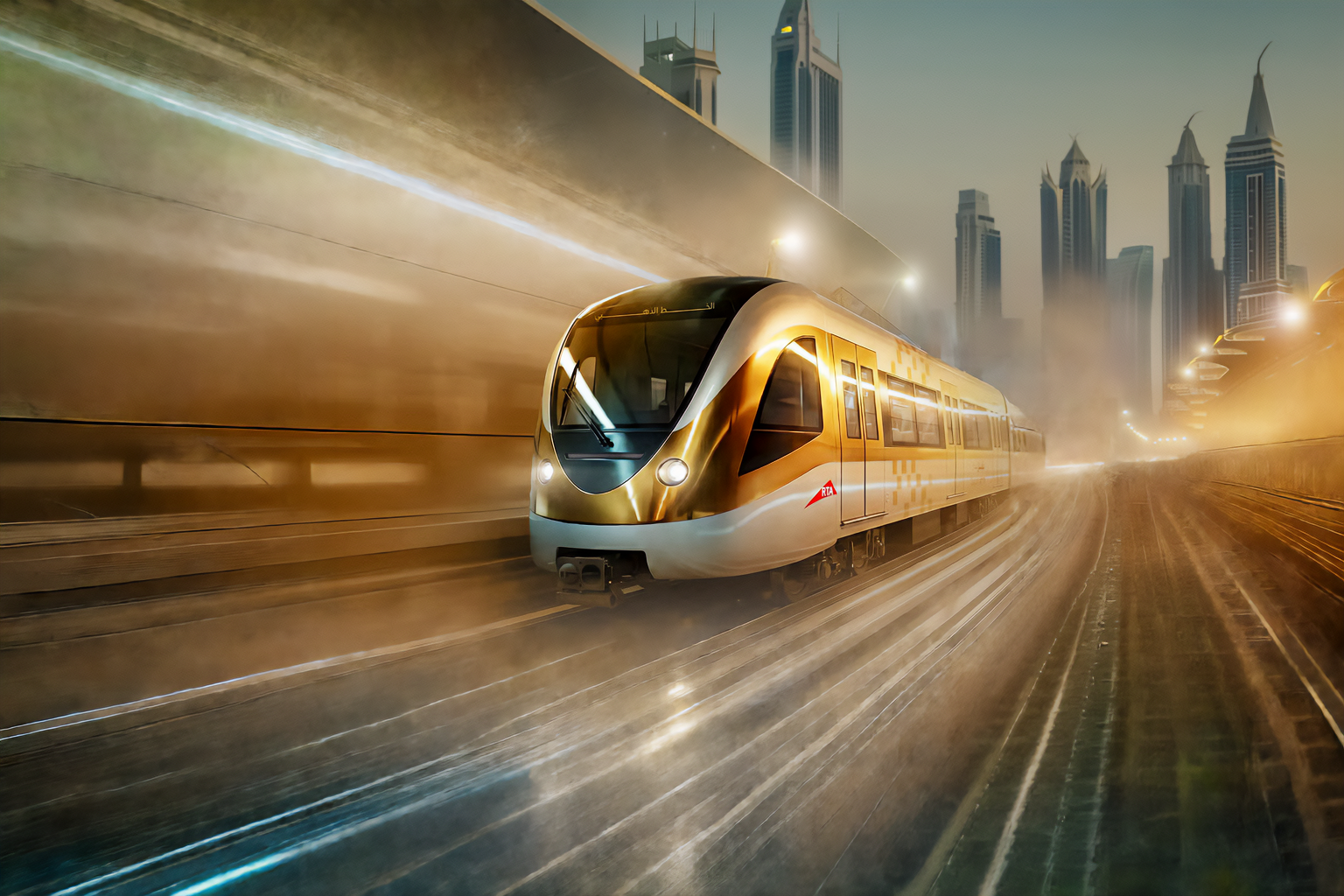
What Is the Dubai Metro Gold Line?
Dubai Metro Gold Line is a Dh34 billion ($9 billion) fully underground metro line announced on April 22, 2026 by Sheikh Mohammed bin Rashid Al Maktoum. It spans 42 kilometres with 18 stations across 15 key strategic areas, running at a depth of up to 40 metres underground. The Dubai Metro Gold Line opens on September 9, 2032 — the 23rd anniversary of the Dubai Metro — and will serve 1.5 million residents while connecting 55 major real estate developments currently under construction. It is the largest transport project in Dubai's history.
Dubai Metro Gold Line has fundamentally changed the infrastructure story of this city. In a single announcement, Sheikh Mohammed extended the metro network's reach into areas that were either poorly served or completely unconnected — Al Barsha, Dubai Hills, Jumeirah Village Circle, Nad Al Sheba and Jumeirah Golf Estates — while simultaneously linking the city's existing metro network to the national Etihad Rail system for the first time.
This is not a minor extension. The Dubai Metro Gold Line adds 42 kilometres to a network that currently spans 78 kilometres across the Red and Green Lines. It is, in practical terms, a second metro network built on top of the first — but underground, faster to build, and engineered to serve the population corridors that have grown fastest since 2015. Every analyst, investor and resident living along this route needs to understand what it means — now, not in 2032.
The scale matters. The Dubai Metro Gold Line expands the total network by 35 per cent when measured against the current Red and Green Lines. When combined with the Blue Line — due in September 2029 — the entire Dubai Metro network will stretch to 162 kilometres and 85 stations by 2032. Dubai is building two metro lines simultaneously. No other city in the region is moving at this speed.
Dubai Metro Gold Line: The Complete 18-Station Route Map
The Dubai Metro Gold Line route is the clearest picture yet of where Dubai's leadership believes the city's population will concentrate through 2040. The route runs from Al Ghubaiba in the historic heart of the city to Jumeirah Golf Estates in the far south-west — threading through the most densely populated, yet least connected, residential corridors in between.
Understanding the Dubai Metro Gold Line station list is essential for property buyers and investors. The line creates four new interchange hubs with existing networks, and introduces metro access to five major residential areas that currently have none.
| Station | Area | Interchange | Property Status | Investment Signal |
|---|---|---|---|---|
| Al Ghubaiba | Historic Dubai / Bur Dubai | Green Line | Established | Hold |
| Business Bay | Business Bay | Red Line | Established / High-demand | Strong Buy |
| Nad Al Sheba | Nad Al Sheba | None (new) | Growing | Buy |
| Meydan | Meydan / Mohammed Bin Rashid City | Etihad Rail | Expanding fast | Strong Buy |
| Al Barsha South | Al Barsha South / Dubai Hills | None (new) | Underserved — high demand | Strong Buy |
| Jumeirah Village Circle | JVC | None (new) | Established — rising rents | Buy |
| Jumeirah Golf Estates | JGE (Terminus) | Red Line + Etihad Rail | Premium / Underconnected | Strong Buy |
Source: RTA Dubai Rail Network Plan 2032 · Urban Terrace analysis · April 2026. Table shows selected key stations. Full route includes 18 stations across 15 strategic areas.
The Dubai Metro Gold Line's strategic logic is unmistakable. It does not duplicate the Red Line. It does not follow a corridor already served. Instead, the Gold Line fills the single biggest gap in Dubai's transport geography — the south-western residential belt — while simultaneously stitching together the historic city core at Al Ghubaiba with the fast-expanding communities at its periphery. This is city-building through infrastructure, executed at a scale that makes the Dubai Metro Gold Line unique not just in the UAE, but globally.
The Dubai Metro Gold Line creates two new Etihad Rail interchanges — at Meydan and Jumeirah Golf Estates. This is significant beyond the city. The Gold Line becomes the first Dubai Metro line to integrate with the national rail network, meaning that a resident in JGE will eventually be able to take a single connected journey to Abu Dhabi, Sharjah or Ras Al Khaimah. No previous metro line offered this. The upgrade to Dubai's connectivity story is national, not local.
Dubai Metro Gold Line Engineering: Why Going 40 Metres Deep Changes Everything
The Dubai Metro Gold Line is not simply a longer version of what Dubai already has. The engineering challenge is categorically different — and the depth is the reason. At 40 metres below ground, the Gold Line tunnels run deeper than most sections of the London Underground and the Paris Métro. No metro line in the Middle East has been built at this depth before.
Why go so deep? Because the Dubai Metro Gold Line runs through the most built-up parts of the city — through Al Barsha, Business Bay, Nad Al Sheba and Dubai Hills — where the surface and shallow sub-surface are already occupied by roads, utilities, foundations and existing infrastructure. The only route available is down.
"The Gold Line will set a record never seen in the Middle East. Deep excavations, complex ventilation, fire safety at 40 metres. It's going to be extraordinary."
Joseph Salem, Partner, Arthur D. Little Middle East — The National, April 2026The tunnel network for the Dubai Metro Gold Line is equivalent to twice the combined length of all existing Dubai Metro tunnels. That is not an exaggeration. The current Red and Green Lines combined have approximately 21 kilometres of tunnel sections. The Gold Line's 42-kilometre fully underground route therefore requires tunneling on a scale the UAE has never attempted. The RTA is targeting construction 30 per cent faster than the Blue Line, which itself is already under active construction. Both projects run simultaneously — a logistical challenge that analysts at Arthur D. Little describe as formidable but achievable.
The other engineering innovation of the Dubai Metro Gold Line is station design at depth. Each station must handle vertical distances equivalent to a four-storey building — access shafts, ventilation systems, fire suppression, evacuation routes and passenger flow management in a confined underground envelope. The RTA has indicated that station design for the Gold Line will follow global best practices developed for deep-bore metro systems in cities including Singapore, London and Stockholm.
The Dubai Metro Gold Line's tunnel network, at twice the length of all existing metro tunnels combined, will require the world's largest tunnel boring machines operating simultaneously across multiple alignments. This scale of underground construction has only been achieved in a small number of global mega-projects. Dubai will complete it in approximately six years — faster than most comparable projects in Europe or Asia.
For residents, the depth of the Dubai Metro Gold Line means something practical: minimal surface disruption during construction. Unlike elevated lines or shallow cut-and-cover tunnels, deep-bore tunneling has almost no visible impact on street level. Communities along the Gold Line route can expect significantly less construction disruption than those near the elevated Red Line experienced in the 2000s. This is one of the Gold Line's under-discussed advantages — the construction phase is largely invisible to the communities it serves.
Dubai Metro Gold Line Property Impact: Which Areas Will See the Biggest Gains
The Dubai Metro Gold Line is the most significant infrastructure catalyst for Dubai's residential property market since the Red Line opened in 2009. Research from Cushman & Wakefield, ValuStrat and fäm Properties consistently shows that properties within 500 metres of a new metro station outperform their submarket by 12–22 per cent in the five years following an opening announcement — not the opening itself. The announcement is the trigger. The market begins to price in metro access from the moment the route is confirmed.
We are now in that window. The Dubai Metro Gold Line was announced on April 22, 2026. The market has had three days to absorb this news. Prices in Al Barsha South, Dubai Hills, Jumeirah Village Circle and Jumeirah Golf Estates have not yet materially adjusted. That adjustment is coming. The question is whether you are positioned before or after it happens.
| Area / Station | Current Avg (AED/sqft) | Metro Access Before Gold Line | Est. Uplift Potential by 2028 | Exit Horizon |
|---|---|---|---|---|
| Al Barsha South | AED 980–1,100 | None | +15–22% | 2032 (Gold Line opens) |
| Dubai Hills Estate | AED 1,580–1,750 | Bus Only | +10–15% | 2030–2032 |
| Jumeirah Village Circle | AED 1,050–1,200 | None | +12–18% | 2032 (Gold Line opens) |
| Nad Al Sheba | AED 1,380–1,520 | None | +10–14% | 2032 (Gold Line opens) |
| Meydan / MBR City | AED 1,420–1,680 | Partial | +12–18% | 2032–2033 |
| Jumeirah Golf Estates | AED 1,300–1,500 | None | +18–25% | 2032 (Gold Line + Etihad Rail) |
| Business Bay | AED 1,800–2,050 | Red Line | +8–12% | 2030–2032 |
Source: fäm Properties, ValuStrat, Allsopp & Allsopp, Betterhomes, REIDIN — Q1 2026 data · Urban Terrace analysis. Uplift estimates are indicative based on historical metro-proximity premiums and do not constitute investment advice.
The Underserved Area Premium
Analysts at Arthur D. Little have described the Dubai Metro Gold Line as an "economic multiplier" — and nowhere is this more accurate than in Al Barsha and Dubai Hills. These are communities with mature infrastructure, strong residential demand, high rental occupancy and above-average household incomes. The only thing they lacked was metro access. The Dubai Metro Gold Line removes that discount. Property in these areas has historically traded at a price-per-sqft below comparable metro-adjacent communities precisely because of transport deficiency. That deficiency is now resolved — in announcement, if not yet in physical delivery.
Jumeirah Golf Estates represents a particular opportunity along the Dubai Metro Gold Line corridor. It sits at the terminus of the Gold Line and simultaneously hosts an Etihad Rail passenger interchange. No other residential community in Dubai will have both a metro terminus and a national rail station. The combination creates a transport hub premium unlike anything currently priced into the Dubai market. At the time of writing, JGE villas trade at AED 1,300–1,500 per sqft — a significant discount to Palm Jumeirah or Emirates Hills, communities with inferior transport access. The Dubai Metro Gold Line changes that equation permanently.
The Dubai Metro Gold Line serves 55 major real estate developments currently under construction. This is not coincidence — it reflects a deliberate alignment between the RTA's network planning and the Dubai 2040 Urban Master Plan. The government is not building infrastructure to serve existing communities alone. It is building infrastructure to enable new ones. Investors who buy into Gold Line-adjacent off-plan projects today are buying with infrastructure certainty. That certainty is rare. Use it.
Our recommendation: prioritise Al Barsha South, Jumeirah Golf Estates and Jumeirah Village Circle in that order. All three are currently under-represented in institutional investment portfolios relative to their post-Gold Line fundamentals. The window to enter at pre-announcement pricing is measured in weeks, not months.
Dubai Metro Gold Line vs Blue Line: A Complete Comparison
The Dubai Metro Gold Line was announced while the Blue Line is already under construction. Dubai is building two major metro expansions simultaneously — and understanding how they differ is essential for investors trying to decide where to focus. The Dubai Metro Gold Line and the Blue Line serve different parts of the city, different demographics and different real estate cycles.
The Dubai Metro Gold Line wins on almost every metric — length, cost, depth, Etihad Rail integration and projected ridership. But this comparison misses the point. The Blue Line and the Gold Line are not in competition. They serve entirely different halves of the city. The Blue Line unlocks the eastern corridor — Mirdif, Silicon Oasis, Creek Harbour. The Dubai Metro Gold Line unlocks the south-western corridor — Al Barsha, Dubai Hills, JVC, JGE. Together, they complete the metro geography of a city that will have 5.8 million residents by 2040, according to the Dubai 2040 Urban Master Plan.
For property investors, the relevant question is not which line is better. It is which line corridor still offers the greatest upside at current prices. Our analysis points clearly to the Dubai Metro Gold Line. The Blue Line corridor has had nearly two years to price in metro proximity premiums since its announcement. The Gold Line corridor had its announcement three days ago. The mispricing window is open. The only question is how long it stays open.
Dubai Metro Gold Line 2026: The Road From Announcement to Opening Day
The Dubai Metro Gold Line operates on a tight but achievable schedule. The RTA has committed to delivering the project by September 9, 2032 — six years and four months from announcement. That is fast by any global standard for a 42-kilometre fully underground metro line. Here is how the Dubai Metro Gold Line gets from today to opening day.
Sheikh Mohammed bin Rashid announces the Dubai Metro Gold Line on April 22, 2026. The Dh34 billion project is confirmed, the route is published, station locations are identified and the September 9, 2032 opening date is set. The RTA begins the process of appointing design consultants.
Preliminary and detailed design work begins. Environmental Impact Assessments are conducted. The RTA appoints a lead engineer and begins the competitive tender process for main civil works contractors. Geotechnical surveys along the Dubai Metro Gold Line alignment are completed to inform tunnel boring specifications.
Civil works contracts are awarded. Tunnel boring machines are ordered and manufactured — a process that itself takes 12–18 months. Site preparation and utility diversions begin across the Dubai Metro Gold Line alignment. The RTA has indicated it will leverage lessons from the Blue Line to accelerate this phase by 30 per cent.
This is the primary construction window for the Dubai Metro Gold Line. Multiple TBMs operate simultaneously along the 42-kilometre alignment. Station boxes at 40-metre depth are excavated and fitted out. Systems integration — track, power, signalling, communications, ventilation — is installed progressively as tunnel sections are completed.
The Dubai Metro Gold Line enters an intensive testing and commissioning period. Rolling stock trials, emergency evacuation drills and systems integration testing are completed. Dubai Civil Aviation Authority and UAE fire safety bodies provide certification. Staff training and operational readiness programmes run in parallel.
The Dubai Metro Gold Line opens to the public on the 23rd anniversary of the Dubai Metro — consistent with the government's tradition of marking milestone anniversaries with major infrastructure openings. All 18 stations are operational from day one, with full interchange connectivity to the Red Line, Green Line and Etihad Rail.
History shows that the largest property price adjustments near new metro stations occur between announcement and construction commencement — not between construction and opening. Once cranes appear on site, the market has already adjusted. The optimal entry window for Dubai Metro Gold Line corridor properties is April–December 2026. After that, the pricing opportunity narrows materially. Urban Terrace recommends acting within the current quarter.
8 Dubai Metro Gold Line Questions — Answered
The Dubai Metro Gold Line has generated more reader questions in three days than any announcement we have covered this year. Here are the eight most important questions — answered with data.
The Dubai Metro Gold Line is a Dh34 billion ($9 billion) fully underground metro line announced on April 22, 2026. It is significant for three reasons. First, it is Dubai's largest single transport investment — larger than the Red Line, the Green Line and the Blue Line combined in cost terms. Second, it is the first Dubai metro line to connect with the national Etihad Rail network, upgrading its function from a city transit system to a national transport node. Third, the Dubai Metro Gold Line serves 1.5 million residents in areas currently without metro access — removing the single biggest structural barrier to property value growth in Al Barsha, Dubai Hills, JVC and Jumeirah Golf Estates.
Source: Dubai Media Office, April 22 2026 · Sheikh Mohammed bin Rashid Al Maktoum official statement · RTA Rail Network Plan 2032The Dubai Metro Gold Line is scheduled to open on September 9, 2032 — exactly the 23rd anniversary of the Dubai Metro. This date was confirmed by Sheikh Mohammed in the official announcement. The RTA has stated that it will build the Dubai Metro Gold Line 30 per cent faster than the Blue Line, leveraging experience from that concurrent project. Transport analysts at Arthur D. Little have reviewed the timeline and consider the 2032 date achievable, describing it as ambitious but consistent with the RTA's track record of on-time delivery for major infrastructure projects in Dubai.
Source: The National, April 24 2026 · Arthur D. Little Middle East statement · RTA official project documentationThe Dubai Metro Gold Line has 18 confirmed stations across 15 strategic locations. The route runs from Al Ghubaiba in historic Bur Dubai to Jumeirah Golf Estates in the south-west. Key stations with interchange connections include Al Ghubaiba (Green Line), Business Bay (Red Line), Meydan (future Etihad Rail) and Jumeirah Golf Estates (Red Line terminus and future Etihad Rail). Other confirmed corridor areas include Nad Al Sheba, Al Barsha South, Jumeirah Village Circle and Mohammed Bin Rashid City. The full Dubai Metro Gold Line station list was published in the Dubai Rail Network Plan 2032 released by the RTA on April 22, 2026.
Source: Khaleej Times, April 22 2026 · RTA Dubai Rail Network Plan 2032 route map · Gulf News, April 22 2026The Dubai Metro Gold Line runs at a depth of up to 40 metres underground. This makes it the deepest metro system in the Middle East and deeper than most sections of the London Underground and Paris Métro. This exceptional depth is required because the Gold Line passes through densely developed urban areas where surface and shallow underground infrastructure already exists. The tunnel network for the Dubai Metro Gold Line is equivalent in total length to twice all existing Dubai Metro tunnels combined. Joseph Salem of Arthur D. Little Middle East noted that the 40-metre depth creates significant engineering challenges around fire safety, ventilation and evacuation management — challenges that will set a regional record once resolved.
Source: The National, April 24 2026 · Arthur D. Little Middle East, Joseph Salem quote · RTA project documentationThe Dubai Metro Gold Line is expected to drive 10–25 per cent price appreciation across its corridor over the 2026–2032 period, with the highest uplifts in areas gaining metro access for the first time — Al Barsha South, JVC and Jumeirah Golf Estates. Historical data from the Red Line opening shows metro-adjacent properties outperformed their submarkets by 12–18 per cent in the five years following an announcement. The Dubai Metro Gold Line amplifies this effect because it simultaneously serves 55 major new real estate developments under construction, increasing both supply and demand in its corridor. ValuStrat and fäm Properties are expected to publish formal corridor analysis reports in the coming weeks.
Source: ValuStrat, fäm Properties, Cushman & Wakefield historical metro impact research · Arthur D. Little Middle East, The National April 2026The Dubai Metro Gold Line creates four key interchange connections. At Al Ghubaiba, it connects with the existing Green Line. At Business Bay, it connects with the Red Line. At Meydan, it connects with a future Etihad Rail passenger station. At Jumeirah Golf Estates, it connects with both the Red Line terminus and a second future Etihad Rail passenger station. This means the Dubai Metro Gold Line is the first Dubai metro line to integrate with the national rail network — enabling journeys beyond the emirate without changing transport modes at the city boundary. The RTA has also indicated that bus rapid transit feeders and last-mile connectivity will be developed along the Gold Line corridor as part of the broader Dubai 2040 transport strategy.
Source: Gulf News, April 22 2026 · RTA Dubai Rail Network Plan 2032 · Khaleej Times, April 22 2026The Dubai Metro Gold Line carries a total project cost of Dh34 billion ($9 billion) — making it Dubai's single largest transport infrastructure investment by a considerable margin. The Blue Line cost Dh20.5 billion; the Gold Line exceeds that by 66 per cent. The project is funded by the Government of Dubai. Official project materials estimate that the Dubai Metro Gold Line will generate cumulative economic returns of up to 430 per cent over 20 years — a figure that encompasses reduced congestion costs, increased productivity, real estate value creation and tourism infrastructure uplift. Sheikh Mohammed's announcement emphasised that Dubai's infrastructure investment programme "will not stop; rather it will accelerate."
Source: The National, April 22 2026 · Dubai Media Office, Sheikh Mohammed official statement · Dubai Chronicle, April 24 2026The Dubai Metro Gold Line creates the strongest investment case in areas that were previously transport-deficient and where prices have therefore lagged fundamentals. Urban Terrace identifies three priority corridors. First, Al Barsha South and Dubai Hills — large, mature residential communities with strong rental demand that will see metro access for the first time. Second, Jumeirah Village Circle — a high-density affordable segment with historically high rental yields that metro access will structurally re-rate. Third, Jumeirah Golf Estates — the Gold Line terminus and dual Etihad Rail interchange, creating a transport hub premium currently not priced into villa values. All three corridors offer 2032 exit timing aligned to the Dubai Metro Gold Line opening, maximising hold period appreciation against a confirmed infrastructure catalyst. Urban Terrace strongly advises engaging with us before the construction announcement phase, which will mark the end of the pre-construction pricing window.
Source: Urban Terrace analysis · fäm Properties, Allsopp & Allsopp, REIDIN Q1 2026 data · ValuStrat metro proximity researchThe Dubai Metro Gold Line is the single most important infrastructure event in Dubai's property market since the Red Line opened in 2009. We have covered many announcements. This one is different. The Dubai Metro Gold Line is not an extension of what exists — it is a parallel network, built deeper, serving more people in less-connected areas, and integrating Dubai into the national rail system for the first time. The implications are structural and permanent.
The Dubai Metro Gold Line creates a six-year investment window with a hard close date. September 9, 2032 is the catalyst. The buying window is now — not in 2028 when cranes are visible, not in 2030 when opening is imminent, and certainly not in 2032 when the market has priced in everything. The Dubai Metro Gold Line announcement is the starting gun. The race for pre-infrastructure positioning starts today.
Our recommendation is clear: Al Barsha South, Jumeirah Golf Estates and Jumeirah Village Circle — in that order — offer the strongest risk-adjusted return profiles along the Dubai Metro Gold Line corridor. Contact Urban Terrace for a corridor-specific briefing. We will identify the exact projects, price points and exit structures that maximise your position.
Position yourself along the
Dubai Metro Gold Line
before the market adjusts.