Urban Terrace Market Intelligence · July 2026
Dubai's Luxury Market Just Had Its Best Half-Year Ever
Dubai luxury real estate 2026 has outrun every regional headwind thrown at it. Knight Frank's mid-year figures show $10 million-plus home sales at an all-time high, wealth-migration data still ranking the UAE among the top destinations on earth, and buyers committing nine figures years ahead of handover on brand-new islands.
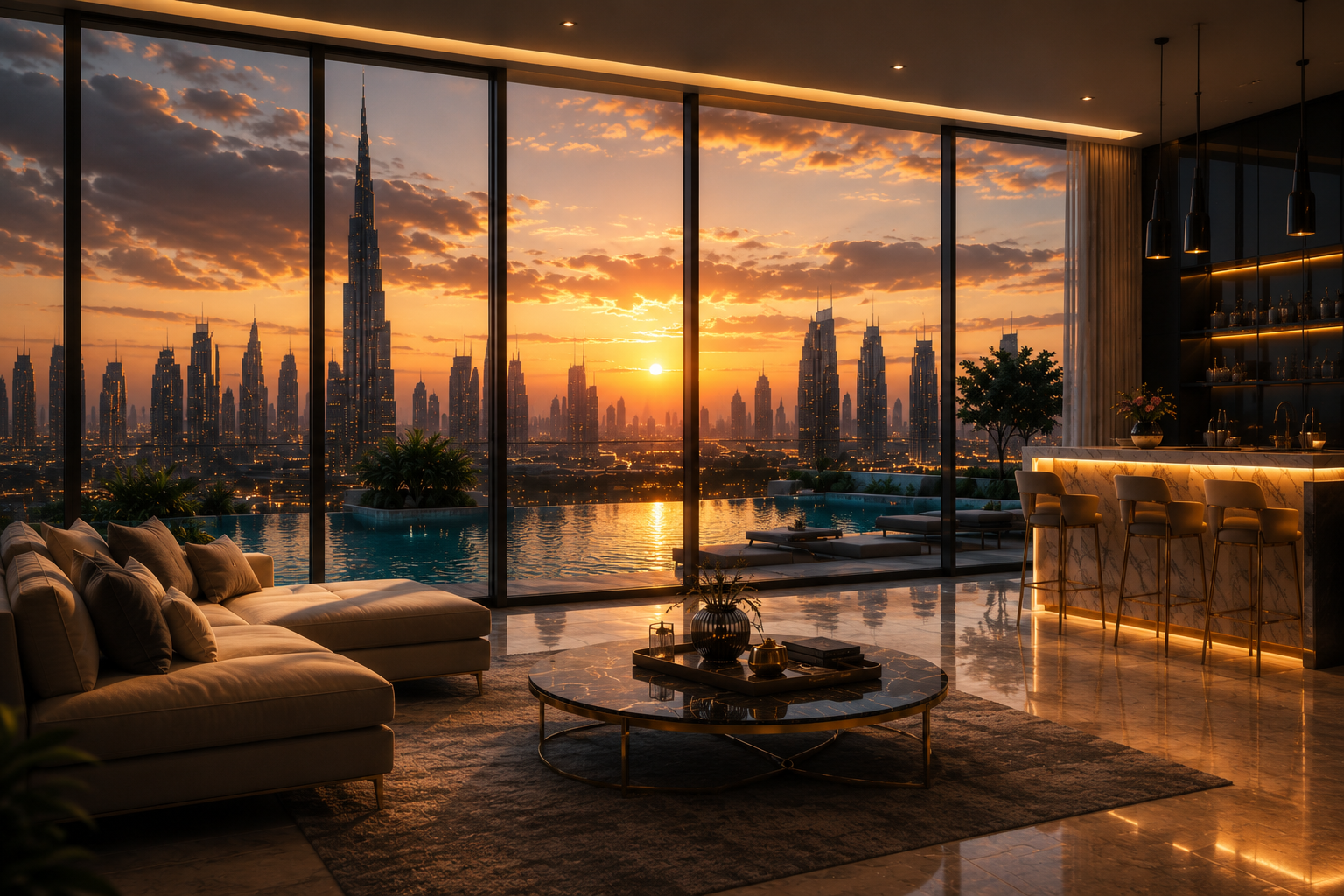
Dubai luxury real estate 2026 is defined by one clear signal: ultra-prime demand has decoupled from short-term regional noise. Knight Frank confirms 296 homes priced above $10 million sold in the first half of the year for a combined $5.1 billion, up 14% year-on-year, with Dubai Hills Estate, Palm Jumeirah and Palm Jebel Ali absorbing the bulk of demand and a record 26 homes selling above $25 million in the second quarter alone. Wealth-migration data continues to rank the UAE among the two most competitive destinations worldwide for relocating millionaires.
Dubai luxury real estate 2026 has delivered its strongest first half on record for the ultra-prime segment, and it did so while the wider region was under genuine strain. That combination, records at the top of the market alongside real geopolitical uncertainty, is the story worth understanding if you're watching this market from anywhere in the world.
Dubai Luxury Real Estate 2026: The Headline Numbers
Dubai luxury real estate 2026 opened strong and never really let up at the top end. Knight Frank's mid-year data shows 165 homes sold above $10 million in the first quarter and a further 131 in the second, taking the half-year total to 296, comfortably Dubai's best first half on record for that price bracket. Combined value reached $5.1 billion, 14% ahead of the first half of 2025 and 49% above the same period in 2024, a pace of growth few global luxury markets can match right now.
The second quarter carried an extra layer of significance: 26 individual homes sold for more than $25 million, itself a new quarterly record. That detail matters more than the headline number, because $25 million-plus buyers are the most discerning segment in the market, family offices, multi-generational wealth, and ultra-high-net-worth individuals who can buy property anywhere on the planet. Their continued appetite for Dubai says as much about the city's long-term positioning as the sales figure itself.
Knight Frank's own research team has also been candid about timing, and it's worth repeating rather than glossing over: a portion of this record reflects deals agreed before regional tensions escalated earlier in the year, with registration typically lagging signing by four to six weeks. Read plainly, that's a point in the market's favor rather than an asterisk against it. It means these deals were already committed before the uncertainty began, and buyers didn't walk away once it arrived.
Where the Money Is Landing: Dubai's Top Luxury Hotspots
Dubai luxury real estate 2026 has a clear geography, and the list holds a genuine surprise. Three communities account for the majority of $10 million-plus deals so far this year. Dubai Hills Estate edged out Palm Jumeirah for the top spot, with 51 ultra-prime sales against 50, while Palm Jebel Ali, an entirely new island community not due for handover until 2028, already ranks third with 40 transactions.
| Rank | Community | Homes Sold Above $10M (H1 2026) | Notable |
|---|---|---|---|
| #1 | Dubai Hills Estate | 51 | Overtook Palm Jumeirah for the top spot this cycle |
| #2 | Palm Jumeirah | 50 | Still the benchmark for waterfront villas |
| #3 | Palm Jebel Ali | 40 | Handover not due until 2028 — sold almost entirely off-plan |
The Palm Jebel Ali number is the one worth sitting with. Forty ultra-prime transactions on an island that won't hand over keys for two more years is a strong statement about buyer confidence in Dubai's development pipeline. These aren't investors hedging their bets on a quick flip, they're buyers willing to commit nine-figure sums years ahead of delivery, on the strength of the developer, the master plan, and Dubai's track record of delivering waterfront communities at scale.
Inside the Deals: Dubai's Landmark Sales of 2026
Dubai luxury real estate 2026 has already produced some of the most expensive residential transactions in the emirate's history. The largest single sale of the first half was a six-bedroom apartment at Aman Residences in Jumeirah Second, which changed hands for $114.9 million (AED 422 million), the third most expensive apartment sale ever recorded in Dubai. A six-bedroom villa on Jumeirah Bay Island followed at $76.3 million, while an 80,000 square foot beachfront plot on Naia Island sold for $152.5 million (AED 560 million), one of the most valuable land deals in UAE history according to Dubai Sotheby's International Realty.
Two of Dubai's three most expensive apartment sales on record, and its priciest land deal ever, have all closed within the same twelve months.
Urban Terrace Research, based on Knight Frank & Dubai Sotheby's data| Property | Location | Price | Type |
|---|---|---|---|
| Naia Island beachfront plot | Naia Island | $152.5M (AED 560M) | Land — most valuable beachfront plot in UAE history |
| Aman Residences apartment | Jumeirah Second | $114.9M (AED 422M) | Apartment — 3rd most expensive ever in Dubai |
| Bugatti Residences (all-time record) | Business Bay | AED 550M | Apartment — Dubai's all-time record sale |
| Como Residences | Nakheel development | AED 500M | Apartment — 2nd highest ever recorded |
| Jumeirah Bay Island villa | Jumeirah Bay Island | $76.3M | Villa |
| Bugatti Residences (June 2026) | Business Bay | AED 200M | Apartment — branded residence |
The Branded Residences Boom
Dubai luxury real estate 2026 has a clear signature at the very top of the market: the brand attached to the building. Bugatti Residences by Binghatti in Business Bay produced Dubai's all-time record apartment sale at AED 550 million, and returned to the headlines again in June 2026 with a separate AED 200 million apartment sale in the same tower. Nakheel's Como Residences, developed with the Como Hotels and Resorts name, sits close behind at AED 500 million, while Aman Residences, part of the ultra-discreet Aman hospitality group, produced the record-setting $114.9 million sale in Jumeirah Second.
The pattern holds across the market: when a globally recognized automotive, hospitality, or fashion name attaches itself to a Dubai tower, buyers consistently pay a clear premium over comparable unbranded stock nearby. For developers, it's a way to differentiate in an increasingly crowded luxury pipeline. For buyers, branded residences bundle a known standard of service, design, and long-term brand equity into what is otherwise a real estate transaction, and 2026's sales data suggests that bundle is only getting more valuable, not less.
Why the World's Wealthy Keep Choosing Dubai
Dubai luxury real estate 2026 doesn't exist in isolation, it's downstream of a much bigger story about where the world's money is choosing to live. Henley & Partners' 2026 Private Wealth Migration Report identifies the UAE as one of only two dominant global destinations for relocating millionaires, alongside Singapore and the wider Southeast Asia region, and notes the UAE has held the top spot for inbound millionaire migration for two consecutive years running.
The clearest single data point behind that ranking: the United Kingdom is projected to lose a record 16,500 millionaires in 2025, nearly double the outflow from China, taking an estimated $91.8 billion in combined wealth with them. The UAE is the single largest beneficiary of that outflow, ahead of the United States. Zero personal income tax, the Golden Visa's long-term residence rights, and Dubai's infrastructure combine into what one wealth-migration publication called the most effective wealth-attraction proposition of the era.
To its credit, Henley & Partners doesn't sugarcoat the test the region faced this year: the firm notes it would be surprising if the UAE repeats its exact number-one ranking given the shock of regional conflict, and frames 2026 as a genuine stress test rather than a formality. But its own conclusion is the more important data point for anyone reading the luxury sales figures above: the Gulf, and Dubai specifically, has proved remarkably resilient through it, and policymakers are, if anything, more motivated to keep wealthy residents feeling welcome, not less.
The Bigger Picture: How the Rest of the Market Is Performing
Dubai luxury real estate 2026 is the standout story, but it sits inside a broader residential market that's still performing at a historically strong level, just not at the extraordinary pace of 2025. Cavendish Maxwell data puts total H1 2026 residential sales at roughly Dh221.3 billion across close to 79,200 transactions, around 14% lower in volume and 15.7% lower in value than the exceptional first half of 2025. Put another way, Dubai just posted its second-strongest half-year on record, behind only the record-breaking year that preceded it.
The month-to-month trend backs up the resilience read. January 2026 was, by transaction value, the strongest single month in Dubai property market history, AED 72.4 billion, up 63% year-on-year, with owner-occupiers behind more than 85% of early-year deals rather than short-term flippers. After a quieter spring, June delivered a sharp rebound: 13,766 sales worth AED 32.66 billion, a 31.3% jump in volume over May. Off-plan sales continue to dominate transaction volume across the wider market, while Dubai's Q1 GDP came in at AED 232 billion, up 2.4% year-on-year and led by the non-oil sector, the kind of broad economic base that supports property demand well beyond any single news cycle. Even the DIFC financial district added to the pipeline this year, awarding the construction contract on its last remaining development plot.
None of this means every segment is accelerating. Dubai's residential price index actually eased slightly in June, its second straight monthly dip, even as prices remained higher than a year earlier. W Capital's CEO, Walid Al Zarooni, has pointed to easing regional tensions and continued population and corporate growth as reasons the second half of 2026 should build on the year's momentum rather than lose it, a reasonable read given how quickly June's numbers turned around after a slower May.
What It Means for Buyers and Investors
Dubai luxury real estate 2026 offers a genuinely different entry conversation depending on where you sit. For end-users and long-term relocators, the fundamentals line up: average residential rental yields of 6.58% (closer to 6.9% for apartments), a Golden Visa pathway tied directly to property investment, zero personal income tax, and an economy growing on a broad, non-oil base. Landlords at the very top of the market have reportedly been choosing to hold their properties rather than sell, a sign of confidence in continued rental demand rather than a rush for the exit.
For investors specifically targeting the $10 million-plus tier, the areas already validated by 2026's data, Dubai Hills Estate, Palm Jumeirah, and increasingly Palm Jebel Ali, remain the highest-conviction plays, while branded residences continue to command a clear premium over unbranded stock at the very top of the market. The wider market's more moderate pace, meanwhile, is arguably good news for anyone buying rather than flipping: less froth, more room to negotiate outside the ultra-prime tier, and a market that typically slows seasonally over the summer before the usual autumn pickup.
This article is market commentary based on published third-party data (Knight Frank, Cavendish Maxwell, Henley & Partners, Engel & Völkers, Dubai Land Department and others), not financial, investment, or legal advice. Property values can fall as well as rise, and anyone considering a purchase at this scale should speak with an independent financial and legal advisor alongside the Urban Terrace team.
Dubai Luxury Real Estate 2026: 8 Questions, Answered
Yes. Knight Frank recorded 296 home sales above $10 million in the first half of 2026, worth $5.1 billion combined, a 14% increase in value over the same period in 2025. Growth held through the second quarter, when regional tensions were most acute, with the segment posting a record 26 sales above $25 million.
Many of these deals were agreed before tensions escalated, with registration lagging signing by four to six weeks, itself a sign buyers didn't walk away once uncertainty arrived.
Source: Knight Frank, H1 2026 data296 homes sold above $10 million in the first half of 2026 alone, 165 in the first quarter and 131 in the second, according to Knight Frank. That's 16% more transactions than the same period in 2025 and 49% more than the first half of 2024.
Source: Knight FrankThe largest confirmed residential sale of the first half was a six-bedroom apartment at Aman Residences in Jumeirah Second, which sold for $114.9 million (AED 422 million), Dubai's third most expensive apartment sale on record. Separately, an 80,000 square foot beachfront plot on Naia Island sold for $152.5 million, one of the most valuable land deals in UAE history.
Source: Knight Frank; Dubai Sotheby's International RealtyDubai Hills Estate leads with 51 home sales above $10 million in H1 2026, narrowly ahead of Palm Jumeirah's 50. Palm Jebel Ali, an island community not due for handover until 2028, ranks third with 40 transactions, a strong early vote of confidence from ultra-prime buyers years before completion.
Source: Knight FrankThe UAE has ranked among the world's top destinations for millionaire migration for two consecutive years, according to Henley & Partners, helped by zero personal income tax, the Golden Visa, and Dubai's infrastructure.
Henley's own analysis frames 2026 as a genuine test of that position given regional conflict, but describes the Gulf as having proved resilient through it so far.
Source: Henley & Partners, Private Wealth Migration Report 2026Average residential rental yields across Dubai sit around 6.58%, with apartments near 6.9%, townhouses around 5.1%, and villas around 4.5%, according to Engel & Völkers' mid-2026 market data. Landlords at the top end of the market have reportedly been holding properties rather than selling, favoring strong rental demand over a sale.
Source: Engel & Völkers, July 2026The data through mid-2026 supports a constructive case: record ultra-prime sales, a top-two global ranking for wealth migration, GDP growth led by non-oil sectors, and rental yields still well above 6% on average. The wider mainstream market has cooled from 2025's exceptional pace, which many analysts view as a healthier, more sustainable backdrop rather than a warning sign.
As with any large purchase, buyers should weigh their own timeline, financing, and risk tolerance, ideally with independent legal and financial advice.
Source: Knight Frank; Cavendish MaxwellThe UAE's Golden Visa grants long-term residence to qualifying property investors and is cited by Henley & Partners and other wealth migration researchers as a central reason the UAE remains a top global destination for relocating millionaires. It's frequently paired with luxury property purchases, since a real estate investment above the qualifying threshold is one of the most direct routes to eligibility.
Source: Henley & Partners, Global Mobility Report 2026Dubai luxury real estate 2026 has passed its toughest test yet without missing a beat at the top end. Record $10 million-plus sales, a new benchmark for $25 million-plus deals, and a top-two global ranking for wealth migration all point the same direction: demand for Dubai's most exclusive addresses is structural, not speculative.
The wider market's more measured pace this year isn't a red flag, it's what a market maturing from an extraordinary 2025 is supposed to look like, and January's record-breaking start plus June's sharp rebound suggest the underlying momentum is intact. For buyers focused on Dubai Hills Estate, Palm Jumeirah, or the next wave of island communities like Palm Jebel Ali, 2026's data gives a genuinely strong case to act rather than wait.
Ready to explore Dubai's luxury market for yourself?