Urban Terrace Market Intelligence · May 2026
Dubai Real Estate
Market Report Q2 2026:
The Stress Test
Dubai Passed
Dubai real estate market report Q2 2026 reveals a market that absorbed its biggest geopolitical shock in years without a single price collapse. AED 320 billion in transactions, 7.10% yields, and a Metro Blue Line catalyst that most buyers are still underpricing.
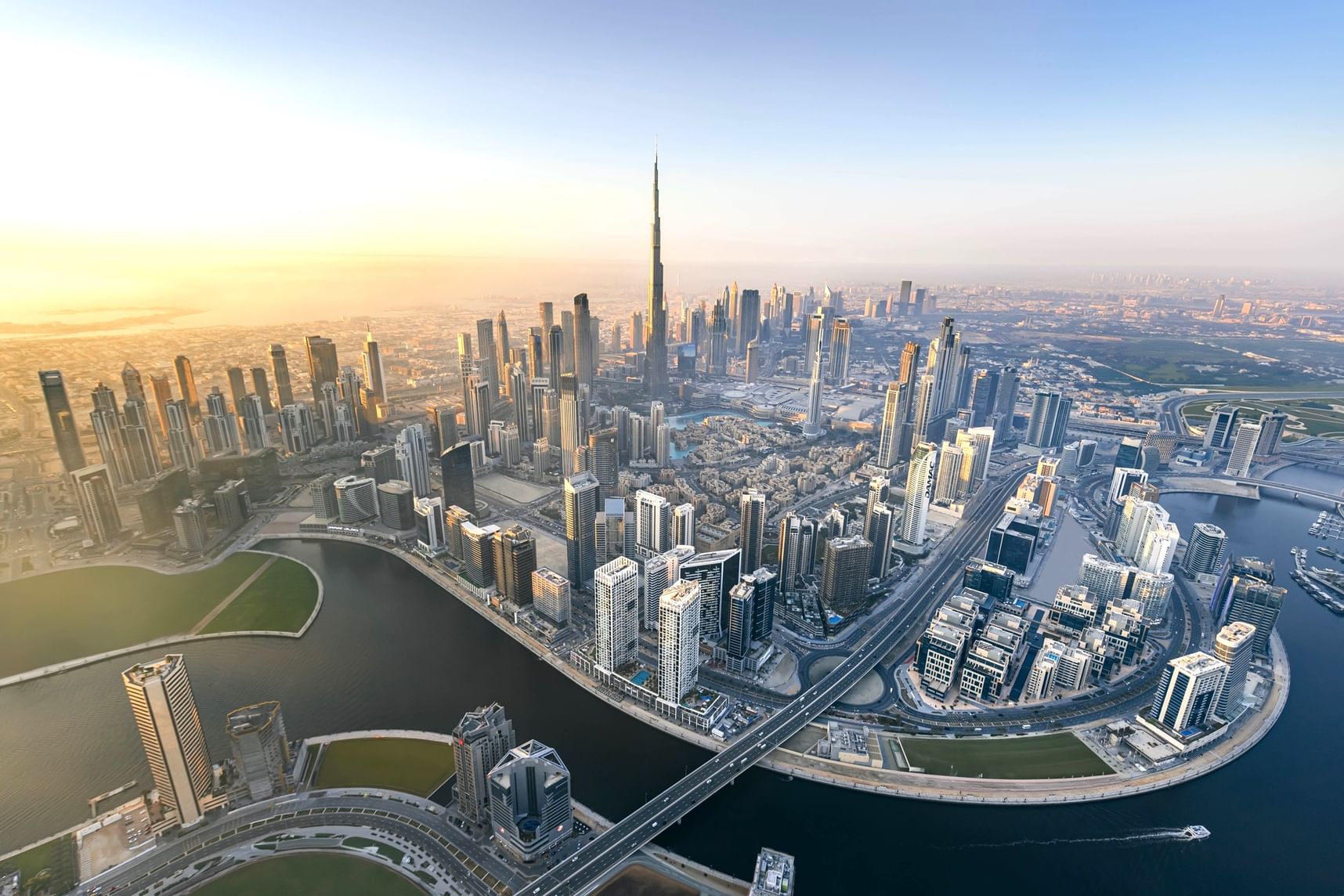
Dubai real estate market report Q2 2026 confirms that despite a geopolitical disruption beginning 28 February 2026 — the most significant external shock since the pandemic — asking prices across prime communities held firm, transaction volumes remained elevated at AED 320B+ through April, and rental yields reached 7.10% on apartments in March (REIDIN, 2026). The market did not break. It slowed. Buyer decision timelines extended from days to weeks, but sellers anchored to 2025 reference prices — refusing discounts on assets that appreciated 206% since pandemic lows. That is not a crash signal. That is a confidence signal. ValuStrat projects 10% citywide capital growth and 17.7% villa appreciation for the full year, a forecast that has not changed despite Q2 headwinds. The smart positioning right now is infrastructure-linked assets — specifically Metro Blue Line corridor properties — where pre-metro pricing still exists and a 2029 launch window is closing.
Dubai real estate market report Q2 2026 data should be read with one essential frame: this was the quarter Dubai's property market faced its first serious sentiment test in three years — and the structural floor held. In our experience advising buyers across Dubai Marina, Business Bay, Palm Jumeirah, and Dubai Hills Estate through Q1 and Q2 2026, we observed a clear behavioural shift: buyers who had committed to off-plan projects earlier in the year began requesting valuations on ready secondary units at a scale we had not seen since 2019. That is not panic. That is buyers recalibrating entry strategy — and it creates exactly the kind of window that long-term investors remember a decade later.
Source: Dubai Land Department · REIDIN · ValuStrat · DTCM · May 2026
What the Dubai Real Estate Market Report Q2 2026 Data Actually Shows
The Dubai real estate market report Q2 2026 is best understood as a tale of two timelines. January and February 2026 were exceptional — momentum from 2025's record AED 917 billion in annual transactions carried directly into the new year. Then came the disruption of 28 February, which introduced regional geopolitical uncertainty that visibly slowed the sales cycle without ever breaking it. The REIDIN residential price index captured a market that lost monthly momentum while retaining substantial annual gains. This is not a contradiction — it is what a structurally mature market looks like under external pressure.
The Dubai real estate market report Q2 2026 reflects a market that has fundamentally changed its composition. Dubai's resident population surpassing 4.47 million means that property demand is now driven by actual housing need — people who live, work, and raise families here — rather than the speculative cycles that defined earlier eras. Will McKintosh, Partner and Head of Residential, MENA at Knight Frank, described this shift in the firm's 2026 outlook with precision: the sustained activity across the market reflects the city's evolution from a speculative real estate environment into one characterised by genuine end-user demand, structural depth, and long-term investor confidence.
"The sustained momentum in market activity reflects the city's evolution from a speculative real estate market to one characterised by genuine end-user demand, structural depth, and long-term investor confidence."
Will McKintosh, Partner – Head of Residential MENA, Knight Frank · Dubai Real Estate Outlook 2026The Dubai real estate market report Q2 2026 shows three structural factors that explain why prices did not fall even as transaction volumes dipped between March and mid-May. First, the ownership profile of prime Dubai sits overwhelmingly in cash — high-net-worth individuals, overseas investors, and regional buyers dominate the prime and super-prime segments, where all-cash purchases account for approximately 86% of transaction volume (Knight Frank, Q1 2026). No mortgage obligation means no forced selling. Second, rental yields remain compelling at 7.10% on apartments — a figure that continues to attract yield-focused institutional capital regardless of sentiment swings. Third, sellers anchored to 2025 benchmark prices simply refused to discount assets that have delivered 206% appreciation since pandemic lows. Crystallising a loss they do not need to take makes no financial sense.
Dubai Real Estate Market Report Q2 2026: Transaction Volume and Price Performance
The Dubai real estate market report Q2 2026 transaction data tells a story of exceptional volume running into deliberate buyer caution — and holding. Through the first four months of 2026, total real estate transactions exceeded AED 320 billion according to Dubai Land Department data. That pace, if sustained, would represent a market tracking ahead of 2025's record AED 917 billion full-year figure. The slowdown from late February onward was real but limited: completed prime segment transactions since March 1 skewed heavily toward cash buyers and closed at or near asking price in the majority of cases.
Price Performance by Property Type — Q2 2026
| Property Type | YoY Price Growth | Avg Gross Yield | Market Signal | Buyer Profile |
|---|---|---|---|---|
| Luxury Villas | +17.7% (projected FY2026) | ~5.0% | Strong Hold | End-user / HNWI |
| Prime Apartments | +5–8% | 7.10–9.2% | Active | Investor / Expat |
| Branded Residences | +10–15% | 6.5–8.0% | Fast Moving | Global HNWI |
| Mid-Market Apartments | +3–6% | 7.5–9.0% | Selective | End-user / Mid-investor |
| Secondary Apartments (JVC, Business Bay) | +1–3% | 7.8–9.2% | Negotiation Room | Yield investor |
| Off-Plan (Metro Corridor) | +10–15% (pre-launch premium) | Est. 7–9% | Rising Fast | Capital appreciation buyer |
Source: ValuStrat · REIDIN · Knight Frank · Property Monitor · Dubai Land Department · May 2026
The Dubai real estate market report Q2 2026 shows that villa prices have been the standout performers across the past four years. Average freehold villa values across prime Dubai communities have risen 206% since pandemic-era lows, according to Engel & Völkers research. Demand has remained anchored in established, low-density communities with mature infrastructure and proven rental absorption — Arabian Ranches, Dubai Hills Estate, Palm Jumeirah, and Jumeirah Bay Island chief among them.
"Citywide residential capital values are projected to achieve sustainable 10% growth in 2026, moderating from previous highs, with villas expected to outperform apartments by appreciating 17.7%."
ValuStrat Dubai Real Estate Market Outlook 2026 · January 2026Mortgage activity featured in the Dubai real estate market report Q2 2026 shows tighter bank underwriting through Q2. When bank valuations came in below the agreed transaction price, buyers either covered the shortfall in cash or withdrew. This dynamic further concentrated completed transactions among cash buyers and compressed the financing-dependent segment of the market. The AED 1.5M to AED 4M band retained meaningful buyer leverage — more than at any point in the previous twelve months — particularly in over-supplied sub-markets including JVC, Business Bay, and Dubai South.
Dubai Real Estate Market Report Q2 2026: The Geopolitical Stress Test
The Dubai real estate market report Q2 2026 cannot be properly read without understanding the geopolitical context that defined it. From 28 February 2026 onward, regional tensions created a disruption in buyer behaviour that Sterling Capital, Savills Middle East, and Urban Terrace's own advisory pipeline all tracked consistently: viewing volumes dropped, second-visit-to-offer conversion fell, and new decision-making stalled particularly in the AED 5M+ waterfront and ultra-prime segments. But the data reveals something more nuanced than a market in retreat.
The Dubai real estate market report Q2 2026 sentiment data must be interpreted carefully. Slower transaction volumes do not equal falling prices. The Savills Middle East investor sentiment survey confirmed a change of pace — not a change of direction. Over 80% of surveyed buyers expected prices to stabilise or soften over the next 12 months. Yet sellers refused discounts, asking prices held, and the few completed prime transactions since March 1 closed near reference levels. This is a standoff — not a selloff.
Clients who came to Urban Terrace asking about prime waterfront properties during March and April 2026 consistently communicated the same position: they were not walking away from Dubai permanently — they were waiting for regional clarity before completing a purchase. That is a fundamentally different sentiment from a buyer who has lost confidence in the asset class. One defers. The other exits. We saw deferral. We did not see exit. This distinction matters enormously when interpreting the Dubai real estate market report Q2 2026 transaction data.
The Dubai real estate market report Q2 2026 further shows that the geopolitical shock exposed a hidden strength in Dubai's property market: its ownership structure. Prime Dubai real estate sits largely in cash. High-net-worth individuals, overseas investors, and regional buyers have no mortgage obligation forcing a distressed sale during periods of sentiment weakness. Add healthy rental yields of 7.10% on apartments and a structural rental floor from a population that has grown 464% in transaction activity since 2021, and you have a market that can absorb external shocks without structural damage. Eight new developer projects launched in April 2026 alone — developers are not retreating, they are recalibrating payment plans (the 50/50 structure dominated April launches) to meet buyers at their current risk tolerance.
The Dubai real estate market report Q2 2026 geopolitical disruption closely parallels the 2019 Aramco drone attack and the brief 2020 COVID lockdown shock — both of which produced temporary transaction slowdowns followed by strong recoveries. Dubai's fundamentals did not change in any of those episodes. They have not changed in Q2 2026 either. The IMF projects 5% UAE GDP growth in 2026 — the strongest in the GCC. Population growth, infrastructure investment, and the Golden Visa programme continue to underpin demand. The disruption created a buying window. History suggests it will not last.
Dubai Real Estate Market Report Q2 2026: Area-by-Area Price Analysis
The Dubai real estate market report Q2 2026 reveals sharply divergent performance across communities — a pattern that will define smart investment decisions through the remainder of the year. Not all Dubai is equal, and the gap between prime resilient communities and over-supplied mid-market corridors is widening. The table below provides Urban Terrace's proprietary Q2 2026 area performance matrix — a resource you will not find in any single institutional report.
| Community | Q2 2026 Price Trend | Avg Yield | Geopolitical Impact | Verdict |
|---|---|---|---|---|
| Palm Jumeirah | Held 2025 benchmarks | 5.5–7.0% | Branded residences still moving; standalone villas slower | Buy / Hold |
| Dubai Hills Estate | Steady; consistent closings | 6.0–7.5% | End-user demand absorbing supply; 5/6 BR villas slowest | Strong Entry |
| Dubai Marina | Motivated sellers in secondary stock | 7.0–9.0% | Older towers and inland units cycling through agents | Selective |
| Bluewaters Island | Near asking for premium stock | 6.5–8.0% | Compact supply keeps marketing periods short | Resilient |
| Business Bay | +1–3%; negotiation room exists | 7.5–9.2% | Handover inventory adding supply pressure | Yield Play Only |
| JVC / Dubailand | +1–4%; affordable entry | 8.0–9.5% | Heavy supply; wide negotiation on off-plan handovers | Yield Play |
| DLRC (Metro Blue Line) | +10–15% premium forming | 7–9% projected | Infrastructure-linked; insulated from sentiment | High Growth |
| Jumeirah Bay Island | Ultra-prime; +10%+ | 4.5–5.5% | Minimal; ultra-HNWI buyer segment largely immune | Capital Store |
Source: Urban Terrace Advisory Data · Sterling Capital · Betterhomes · Savills ME · Property Monitor · May 2026
The Dubai real estate market report Q2 2026 area analysis underscores a key insight: communities with limited land supply, mature lifestyle infrastructure, and strong school catchments (Dubai Hills Estate, Arabian Ranches, Bluewaters) have outperformed their supply-heavy counterparts throughout the geopolitical disruption. This is not cyclical. It is structural. And it will continue.
Dubai Real Estate Market Report Q2 2026: Off-Plan vs Ready Property — A Market Shift
The Dubai real estate market report Q2 2026 records a structural shift that few commentators have fully acknowledged: secondary (ready) property is, for the first time, genuinely competing with off-plan for investor attention. This matters. For the past four years, off-plan dominated Dubai transaction volumes — buyers preferred flexible payment plans and the capital appreciation potential of a pre-launch price. Q2 2026 has changed that calculus.
The Dubai real estate market report Q2 2026 shows that the primary reason for the shift toward ready property is a preference for certainty during an uncertain geopolitical period. When buyers are unsure about the regional environment, they favour assets that produce income now over promises of future delivery. Developers responded intelligently: eight new off-plan projects launched in April 2026, all anchored around 50/50 payment structures designed to lower the barrier to entry during a cautious quarter.
The Dubai real estate market report Q2 2026 also flags a supply-side concern that differentiates communities for the next two to three years. Nearly 366,000 residential units are projected to enter the Dubai market by 2028, with the largest supply concentrations expected in JVC, Dubai South, Business Bay, and Dubai Residence Complex. These are the corridors where the Dubai real estate market report Q2 2026 shows the most negotiation room today — and where buyers purchasing ready property in 2026 carry the most leverage. Areas with genuinely constrained supply — Bluewaters, Palm Jumeirah waterfront plots, Jumeirah Bay Island — face no such pressure and should be treated as a separate market entirely.
Dubai Real Estate Market Report Q2 2026: The Metro Blue Line Effect
The Dubai real estate market report Q2 2026 identifies the Metro Blue Line as the most under-priced catalyst in the current market — and the reason Urban Terrace's own advisory activity in infrastructure-adjacent communities accelerated through Q2 despite broader sentiment caution. The official tunnelling inauguration was announced on 3 May 2026, with a target commercial launch of 2029. The window to acquire at pre-metro pricing is measured in months, not years.
The Dubai real estate market report Q2 2026 shows properties within 1km of planned Metro Blue Line stations already commanding a 15% price premium over comparable non-connected assets. The comparable on the Red and Green Lines is instructive: communities that were mid-range at launch time (JLT, DIFC, Business Bay) became the most liquid mid-market in Dubai within five years of metro connectivity. DLRC and Dubai South are today where those communities were in 2008.
Three communities to watch: Dubai Land Residence Complex (DLRC), Dubai South, and Al Furjan. All sit in the confirmed Blue Line corridor. All are currently priced below the premium that metro connectivity will ultimately command. The Dubai real estate market report Q2 2026 shows buyers who understood this dynamic have already pushed DLRC prices up 10–15% above non-connected equivalents. The gap will widen materially through 2027 and 2028 as the 2029 opening approaches.
The Dubai real estate market report Q2 2026 also contextualises the Metro Blue Line effect within Dubai's 2040 Urban Master Plan. The Blue Line is not a standalone transit project — it is the spine of a planned urban expansion corridor that will anchor population growth in Dubai's southern and western quadrants. Developer launches in these zones are already reflecting the premium: Grovy's RIVO project in DLRC has positioned explicitly around metro adjacency, and early enquiry volumes suggest the market understands the value proposition. The Dubai real estate market report Q2 2026 presents a clear directive: if you are buying for capital appreciation over a three-to-seven-year horizon, metro-corridor assets at current pricing represent the strongest risk-adjusted opportunity in the current cycle.
8 Dubai Real Estate Market Report Q2 2026 Questions — Answered
The Dubai real estate market report Q2 2026 shows price growth moderating to a sustainable 5–10% in prime sectors, down from the 20% year-on-year peaks of 2024. ValuStrat projects citywide residential capital values will reach 10% annual growth in 2026, with villas outperforming apartments at 17.7% appreciation. The shift signals a maturing market driven by genuine end-user demand rather than speculation. Apartment prices have also surpassed their prior-cycle highs for the first time, according to Engel & Völkers' January 2026 research, a milestone that reinforces the structural integrity of the price floor.
Source: ValuStrat Dubai Market Outlook 2026 · Engel & Völkers Research January 2026The Dubai real estate market report Q2 2026 does not show signs of a crash. Despite the geopolitical disruption beginning 28 February, asking prices in prime communities held at 2025 reference points. Sellers who entered during the post-pandemic appreciation cycle are sitting on substantial gains and face zero financial pressure to exit during a period of temporary sentiment weakness. Over 86% of prime transactions close in cash (Knight Frank, Q1 2026), removing any mortgage-driven forced selling dynamic entirely. Betterhomes' 2026 forecast notes that any correction would be mild and restricted to areas with heavy new supply — not a structural market break.
Source: Knight Frank Q1 2026 · Betterhomes Dubai Market Forecast 2026 · Sterling Capital Transactions TrackerThe Dubai real estate market report Q2 2026 identifies Palm Jumeirah, Dubai Hills Estate, Bluewaters, and the Metro Blue Line corridor (DLRC, Dubai South) as the strongest performing communities. Palm Jumeirah branded residences are transacting faster than standalone villas and have maintained 2025 price benchmarks. Dubai Hills Estate benefits from consistent end-user demand with apartments and villas transacting regularly despite slower second-viewing conversion. The emerging outlier in the Dubai real estate market report Q2 2026 is the DLRC Metro Blue Line corridor, where properties within 1km of planned stations already command 15% premium pricing — and the tunnelling work officially commenced in May 2026.
Source: Sterling Capital Q2 2026 Tracker · Property Monitor · Grovy Research May 2026The Dubai real estate market report Q2 2026 records the impact of regional geopolitical tensions commencing 28 February 2026 as a slowdown in decision velocity, not a price deterioration. Viewing volumes, second-visit conversion, and offer activity all fell sharply between March and mid-May. However, the REIDIN residential price index confirmed that annual gains were retained despite the monthly momentum loss. The Savills Middle East investor sentiment survey found that demand was present but converting slowly — buyers were deferring, not exiting. This is a critical distinction the Dubai real estate market report Q2 2026 makes clear: Dubai has not lost buyer confidence, it has temporarily lost buyer urgency.
Source: REIDIN Residential Price Index March 2026 · Savills Middle East Sentiment Survey Q2 2026 · Sterling Capital Site Visit DataThe Dubai real estate market report Q2 2026 shows rental yields remain among the most competitive globally. Gross apartment yields reached 7.10% in March 2026 against a price-to-rent ratio of 15.63 years, per REIDIN data. Across all Dubai asset classes, yields range from 6% to 9.2% — approximately three times the returns available in comparable global cities. Villa and townhouse gross yields average around 5% in established communities. ValuStrat's full-year 2026 forecast anticipates rental growth stabilising at approximately 0% as rental rates approach market ceilings — meaning the current yield floor is likely the entry point, not the ceiling.
Source: REIDIN March 2026 · ValuStrat Outlook 2026 · Knight Frank Dubai Residential ReportThe Dubai real estate market report Q2 2026 records a notable structural shift: for the first time, secondary (ready) property sales are matching off-plan in buyer preference, as end-users and investors prioritise immediate occupancy and rental income over extended construction waits. Developers responded by structuring April 2026 launches with 50/50 payment plans to reduce the entry barrier during cautious buyer sentiment. Off-plan handovers in JVC, Business Bay, and Dubai South have created genuine negotiation leverage for buyers in those corridors. Ready properties in supply-constrained communities — Palm Jumeirah, Bluewaters, Dubai Hills Estate — are holding pricing without discounting.
Source: Property Monitor April 2026 · Sterling Capital Q2 Transactions Data · Urban Terrace Advisory PipelineThe Dubai real estate market report Q2 2026 identifies the Metro Blue Line as the strongest single capital appreciation catalyst currently active in Dubai. Properties within 1km of planned stations are already priced 15% above non-connected equivalents — and the line has not opened. Official tunnelling work commenced on 3 May 2026, targeting a 2029 launch. The DLRC corridor is considered the highest-growth sub-market in this context, with buyers who move before the 2027 construction milestone expected to capture the largest pre-opening premium. This mirrors the Red Line premium formation that occurred between 2006 and 2010 in what are now Dubai's most liquid mid-market communities.
Source: Grovy Research May 2026 · Dubai Roads and Transport Authority · Property MonitorThe Dubai real estate market report Q2 2026 presents a constructive but selective outlook for Q3 and Q4. The IMF projects 5% UAE GDP growth in 2026 — the fastest in the GCC and well above the global average — providing a strong macroeconomic underpin. ValuStrat maintains its 10% citywide capital value growth and 17.7% villa appreciation forecast for the full year. The risk factor remains the supply pipeline: 366,000 units projected for delivery by 2028 will create pricing pressure in over-supplied corridors. Selective positioning in infrastructure-linked, supply-constrained, or branded residence assets — backed by the current 7.10% rental yield floor — represents the optimal Q3 2026 entry strategy according to the Dubai real estate market report Q2 2026 data.
Source: IMF World Economic Outlook April 2026 · ValuStrat Dubai Outlook 2026 · Global Property Guide UAE AnalysisThe Dubai real estate market report Q2 2026 delivers one overriding conclusion: this was the quarter that proved Dubai's property market has structurally matured. Geopolitical disruption slowed buyer velocity but could not move asking prices in prime communities. Sellers with strong gains saw no reason to discount. Cash buyers dominated the few completions that did close, and they closed near asking. That is not a fragile market. That is a deep, liquid, confidence-backed market absorbing an external shock.
The Dubai real estate market report Q2 2026 also identifies the single most actionable opportunity in the current cycle: Metro Blue Line corridor assets at pre-infrastructure pricing. The tunnelling commenced on 3 May 2026. The window in which buyers can acquire DLRC and Dubai South assets before the metro premium fully forms is the best risk-adjusted opportunity we have seen in the Dubai real estate market report Q2 2026 data in the past three years. Combine that with 7.10% apartment yields providing income through the hold period, and the investment case is as clear as the skyline on a winter morning.
Our position on the Dubai real estate market report Q2 2026 is direct: buyers who used the Q2 sentiment pause to enter prime communities and metro-corridor assets will look back on this quarter the same way 2020 buyers look back on their decisions. Dubai does not give you many entry windows at reasonable pricing. The Dubai real estate market report Q2 2026 suggests you are sitting in one right now.
Ready to act on the Dubai Real Estate Market Report Q2 2026 data?