Urban Terrace Market Intelligence · May 2026
Dubai Villas vs Apartments:
Where Should Investors
Put Their Money
in 2026?
Dubai villas vs apartments 2026 is the most searched investment question in the Emirates right now. Villas are up 206% since COVID. Apartments yield 9%+. The honest answer depends on one thing: what you are actually optimising for.
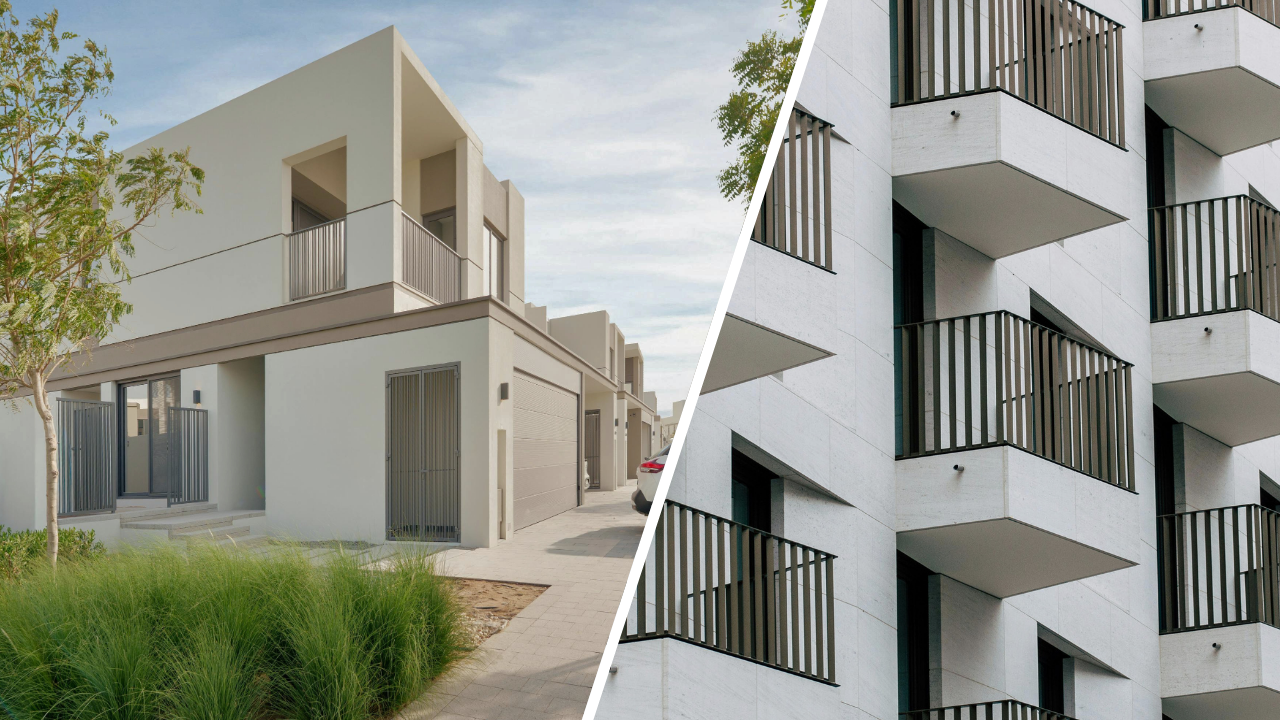
Dubai Villas vs Apartments 2026: The Answer No One Wants to Give You
Dubai villas vs apartments 2026 does not have a single winner — it has two answers for two types of investor. If your goal is capital appreciation over 5+ years and your budget exceeds AED 2.75M, buy a villa. Freehold villa values are up 206% since the pandemic, supply is structurally constrained, and ValuStrat forecasts a further 17.7% appreciation in 2026 alone. If your goal is rental income from day one, buy an apartment. Apartments average 7% gross yield — rising to 9%+ in JVC — on a zero-income-tax basis that no comparable global city can match. The only wrong answer is choosing the wrong asset for the wrong objective.
Dubai villas vs apartments 2026 is not a debate that should be decided by opinion. It should be decided by data, budget, and investment horizon — in that order. The market has split into two distinct performance tracks, and the gap between them is now wide enough that getting this decision wrong is expensive. This analysis gives you the unfiltered numbers.
Dubai Villas vs Apartments 2026: What the Transaction Data Actually Shows
Dubai villas vs apartments 2026 analysis begins with the January 2026 DLD transaction data, which reveals a market that is bifurcating in ways that demand attention. Total real estate transaction value hit AED 72.4 billion — the highest single month in Dubai's history — with the primary market up 90% and secondary market up 38% year-on-year (Property Finder, February 2026). But within those headline figures, villas and apartments are telling sharply different stories.
The villa segment has been defined by scarcity-driven repricing. Villa transaction volumes have grown more slowly than apartments — simply because there are fewer assets to sell and fewer sellers willing to exit assets that keep appreciating. When villas do transact, they do so at premium prices. In 2025, the overall villa and townhouse segment recorded transaction values that outpaced the apartment segment on a per-square-foot basis by a growing margin, according to Allsopp & Allsopp's 2025 annual review.
The apartment segment tells a different story — one of volume-driven growth powered by end-user demand, mortgage financing, and rental investor activity. More than 80% of mortgage-backed transactions in 2025 were secured on apartments, according to DLD data. Apartment prices surpassed their previous 2014 cycle highs for the first time in January 2026 (Engel & Völkers), confirming that buyers are no longer discounting for prior-cycle memory. Ready secondary apartment values jumped 48% year-on-year in January 2026. The market has validated the apartment's position as the primary liquid investment asset in Dubai.
Every broker in Dubai will tell you villas are the smart play right now. That is true — but it is also incomplete. The contrarian observation on dubai villas vs apartments 2026 is this: apartments are the more misunderstood asset in the market. Investors are fixated on villa capital growth and dismissing apartments as secondary choices. Meanwhile, JVC apartments are producing 9%+ gross yields with 13% annual rent growth and zero income tax. On a risk-adjusted, after-tax return basis, a well-selected apartment in a high-demand node is outperforming many villa positions when you account for the larger capital outlay required for villas. Size your comparison correctly before you conclude.
The genuinely smart play on dubai villas vs apartments 2026 is not choosing one. It is understanding the role each plays in a portfolio — and funding both if your capital allows.
Dubai Villas vs Apartments 2026: Capital Growth — The Full Comparison
Dubai villas vs apartments 2026 on capital growth is not a close contest at the market-wide level. Villas win. But understanding why they win — and whether that advantage is sustainable — requires going deeper than the headline +206% figure.
The villa appreciation story is fundamentally a supply story. Established freehold villa communities in Dubai — Palm Jumeirah, Dubai Hills Estate, Jumeirah Islands, Emirates Hills, Sobha Hartland — have limited and declining resale supply. When a villa owner in Dubai Hills Estate is sitting on a 206% gain since 2020, the incentive to sell is low. That constrains supply. Post-pandemic demand from relocated HNWIs and family-oriented end-users simultaneously surged. The classic supply-demand squeeze drove prices to levels that most models did not anticipate. ValuStrat now forecasts villa prices to appreciate a further 17.7% in 2026 — nearly double the 10% citywide residential average.
The apartment capital growth story is about recovery completing and then new ground being broken. Apartments in Dubai spent years trading below their 2014 cycle peaks, suppressing both confidence and speculative demand. The crossing of that prior-cycle high in January 2026 — confirmed by Engel & Völkers data — is a structural signal that the market is entering a new phase, not just recovering from a trough. In prime apartment zones, 2026 price appreciation of 10–16% is being recorded. That is strong absolute performance, even if it falls short of villa growth rates.
| Asset Type & Area | Since-Pandemic Gain | 12M Change (2025) | 2026 Forecast | Supply Outlook | UT Signal |
|---|---|---|---|---|---|
| Villa — Palm Jumeirah | +200–220% | +20–24% | +15–20% | Severely constrained | Premium Hold |
| Villa — Dubai Hills Estate | +190–210% | +17–20% | +15–18% | Low | Strong Buy |
| Villa — DAMAC Lagoons | +120–140% | +14–18% | +12–16% | Low–Medium | Buy |
| Apartment — Downtown Dubai | +65–80% | +13–16% | +10–14% | Low–Medium | Buy |
| Apartment — Dubai Marina | +55–70% | +11–14% | +9–12% | Medium | Buy |
| Apartment — JVC | +60–75% | +10–13% | +8–11% | Medium–High | Income Buy |
| Apartment — Business Bay | +60–75% | +10–13% | +8–12% | Medium | Buy |
| Townhouse — Emaar South | +90–110% | +12–15% | +10–14% | Low | Early Entry |
Source: Knight Frank Q4 2025 · ValuStrat 2026 Outlook · Engel & Völkers · Urban Terrace Research. Not financial advice.
"On dubai villas vs apartments 2026 capital growth, villas win the headline. But the real alpha in this market is identifying apartments in supply-constrained communities before the tourist investment flow discovers them."
— Vaneesh Manchanda, Managing Partner, Urban Terrace Real EstateDubai Villas vs Apartments 2026: The Rental Yield Reality
Dubai villas vs apartments 2026 on rental yield is one of the most important — and most misunderstood — comparisons in the market. Many investors gravitate toward villas because they read the capital growth headlines and assume yield follows. It does not. Apartments yield more, consistently and significantly, and the gap in 2026 is wider than at any point in the past decade.
Average gross rental yield for apartments in Dubai stood at approximately 7% at end-2025, according to Knight Frank. In JVC, the figure rises to 8–9%+, driven by a 13% annual rent increase that lifted average one-bedroom rents to AED 72,500 per year. Business Bay delivers 6.5–7%. Dubai Marina holds 6.5–7.2%. Downtown Dubai, despite commanding the highest absolute rents — AED 127,000 per year for a one-bedroom — yields approximately 5–5.8% on elevated prices. Villa and townhouse gross yields sit at 4.5–5.5% across the market. Palm Jumeirah villas — the most prized assets — yield as little as 3.8–4.5% gross at current valuations.
The tax context transforms this comparison. Dubai's zero-income-tax environment means every percentage point of gross yield translates almost directly to net return. A 7% gross Dubai apartment yield competes with a 2–3% net yield in London, 2–2.5% in Singapore, and 1.5–2.5% in Paris — all after 20–45% income tax is applied. Dubai villas vs apartments 2026 on an after-tax global yield comparison is not close. Both asset types dramatically outperform international alternatives, but the apartment lead on yield is decisive within the local market.
| Community | Asset Type | Avg 1BR Annual Rent | YoY Rent Growth | Gross Yield | Tax Rate | Effective Net Yield |
|---|---|---|---|---|---|---|
| JVC | Apartment | AED 72,500 | +13% | 8.0–9.2% | 0% | 6.5–7.5% |
| Business Bay | Apartment | AED 99,000 | +10% | 6.5–7.0% | 0% | 5.3–5.8% |
| Dubai Marina | Apartment | AED 102,000 | +9% | 6.5–7.2% | 0% | 5.3–5.9% |
| Downtown Dubai | Apartment | AED 127,000 | +8% | 5.0–5.8% | 0% | 4.1–4.7% |
| Dubai Hills Estate | Villa (4BR) | AED 380,000+ | +12% | 4.6–5.2% | 0% | 3.7–4.2% |
| DAMAC Lagoons | Villa / TH | AED 200,000–280,000 | +10% | 4.9–5.5% | 0% | 4.0–4.5% |
| Palm Jumeirah | Villa | AED 700,000+ | +15% | 3.8–4.5% | 0% | 3.0–3.7% |
Source: Knight Frank Q4 2025 · fäm Properties · Allsopp & Allsopp · Urban Terrace Research. Net yield estimated after service charges; excludes finance costs. Not financial advice.
Dubai villas vs apartments 2026 does not have to be an either/or decision for investors with sufficient capital. The optimal portfolio structure combines a villa in an established community for capital appreciation and a one- or two-bedroom apartment in JVC or Business Bay for yield. The apartment funds carrying costs and management fees across the portfolio, while the villa compounds quietly in the background. Urban Terrace advisors can model this dual-asset structure for your specific budget.
Dubai Villas vs Apartments 2026: True Cost of Entry — What Brokers Don't Tell You
Dubai villas vs apartments 2026 cost comparison is routinely oversimplified to the purchase price. The real cost of entry includes Dubai Land Department transfer fee (4% of purchase price), agent commission (typically 2%), mortgage arrangement fees if financing, and ongoing service charges. When you run these numbers across asset types and communities, the picture changes significantly for villa buyers.
| Asset | Entry Price Range | DLD Transfer (4%) | Annual Service Charge | Typical Mortgage LTV | Total Year 1 Cost* |
|---|---|---|---|---|---|
| Studio / 1BR Apt (JVC) | AED 600K–1.1M | AED 24K–44K | AED 8K–14K | Up to 80% | AED 180K–330K cash |
| 1BR–2BR Apt (Marina / Bay) | AED 1.2M–2.5M | AED 48K–100K | AED 12K–22K | Up to 80% | AED 350K–750K cash |
| 2BR–3BR Apt (Downtown) | AED 2.5M–5M | AED 100K–200K | AED 20K–40K | Up to 75% | AED 750K–1.5M cash |
| TH / Villa (DAMAC Lagoons) | AED 2.75M–4M | AED 110K–160K | AED 18K–30K | Up to 75% | AED 800K–1.2M cash |
| Villa (Dubai Hills Estate) | AED 4M–9M | AED 160K–360K | AED 30K–60K | Up to 75% | AED 1.2M–2.7M cash |
| Villa (Palm Jumeirah) | AED 15M–80M+ | AED 600K–3.2M | AED 100K–400K | Up to 65% | AED 5.25M–28M cash |
*Total Year 1 Cash = 20–35% down payment + DLD + agent + service charge (Year 1). Mortgage cases only. Cash buyers add full purchase price. Estimates only — consult Urban Terrace for precise figures.
Dubai villas vs apartments 2026 buyers frequently underestimate villa service charges. Large villas in premium communities carry annual community fees of AED 30,000–AED 400,000, plus maintenance costs that fall entirely on the owner. Apartments in managed towers have service charges too, but they are typically lower per AED of asset value and maintenance is handled by the building. Factor the full ongoing cost into your yield calculation before committing. A villa yielding 5% gross at AED 5M becomes a 3.5% net position when service charges, maintenance, and vacancy periods are correctly accounted for.
Dubai Villas vs Apartments 2026: Best Communities Ranked by Investor Profile
Dubai villas vs apartments 2026 community selection is where most investors make or lose money. The right asset in the wrong community underperforms. Below is Urban Terrace's exclusive ranking — the only combined villa-and-apartment community table structured by investor profile that you will find in the Dubai market today.
Top Villa Communities — 2026 Ranking
Dubai villas vs apartments 2026 for villa investors: Dubai Hills Estate remains the benchmark. AED 2,200–2,700/sqft. Emaar pedigree with an established 18-hole golf course, Dubai Hills Mall, and the new Dubai Metro Blue Line extension improving connectivity. Villas have appreciated 17–20% in the past 12 months and face limited new supply within the community. Ideal for investors seeking a combination of long-term capital growth, strong resale liquidity, and a family-grade lifestyle destination.
Dubai villas vs apartments 2026 for off-plan villa investors: Sobha Sanctuary is the standout new launch. Nature-integrated master community on the banks of Dubai Creek, developed by Sobha Realty — one of the only vertically integrated developers in the emirate who controls their own construction quality. From AED 4M with handover in Q3 2029. Sobha's track record of on-time delivery and build quality above market standard justifies the premium entry. Best suited for investors with a 3–4 year horizon and AED 4M+ budget.
Dubai villas vs apartments 2026 for investors seeking maximum size at minimum price: DAMAC Lagoons and the new DAMAC Islands 2 from AED 2.75M offer the most compelling villa value proposition in the 2026 market. Water-themed master communities with 4–5 bedroom villas at AED 1,350–1,650/sqft — roughly half the price of Dubai Hills Estate for a significantly larger footprint. Rental yields of 4.9–5.5% are the highest in the villa segment. Best for investors who prioritise size and yield over brand prestige.
Dubai villas vs apartments 2026 for ultra-HNWIs: Palm Jumeirah villa acquisition is a wealth preservation and lifestyle decision as much as an investment thesis. AED 4,800–6,200/sqft. Supply is permanently finite. Values have risen 200–220% since the pandemic and continue to appreciate. Yield is lower at 3.8–4.5% gross, but capital preservation and global name recognition make this the most internationally liquid residential asset in the Middle East. No substitute exists in the Dubai market for the Palm villa proposition.
Top Apartment Communities — 2026 Ranking
Dubai villas vs apartments 2026 for income-focused investors: Jumeirah Village Circle is unmatched. 8–9%+ gross yield, 13% annual rent growth, AED 1,050–1,350/sqft. The community has transitioned from a speculative play to an established residential destination with critical mass of residents, retail infrastructure, and strong tenant demand from mid-income professionals. Supply pressure is the main watch point — but quality buildings with managed amenities in JVC continue to outperform. Best suited for investors prioritising income with AED 600K–1.4M budget.
Dubai villas vs apartments 2026 for investors seeking the best risk-adjusted return on apartments: Business Bay delivers. AED 2,000–2,400/sqft. Proximity to DIFC and Downtown generates consistent corporate tenant demand. Rents grew 10% in 2025 to approximately AED 99,000 per year for a one-bedroom. Gross yield of 6.5–7% with 10–13% annual price appreciation creates a total return profile that is hard to match in any comparable global city. Deep secondary market liquidity supports exit planning. Best for investors with AED 1.5M–3M.
Dubai villas vs apartments 2026 for investors with a contrarian, early-entry mindset: Dubai Islands is where the structural growth trade is being positioned right now. A 17-square-kilometre master development off the Deira coast with 5 islands, 20km of beachfront, 6 marinas, and a Nakheel-backed infrastructure programme. Current off-plan entry at AED 1,500–2,100/sqft. Flora Bay Residences represents one of the most compelling beachfront apartment positions available at current pricing. Investors who positioned in Dubai Marina in 2010 or Palm Jumeirah in 2005 understand this trade.
Dubai Villas vs Apartments 2026: A Decision Framework by Investor Profile
Dubai villas vs apartments 2026 ultimately comes down to three variables: investment objective, budget, and time horizon. The comparison strip below maps the right asset class to the right investor profile with precision. Print this and use it before you make a decision.
The most sophisticated investors engaging with the dubai villas vs apartments 2026 decision are not choosing between the two. They are building a two-asset structure: a villa in an established community to compound capital over 7–10 years, and one or two income-generating apartments in high-yield nodes to fund the carrying costs of the entire portfolio. This structure produces a blended portfolio yield of approximately 5–6% net on a tax-free basis while simultaneously generating the capital growth that villas deliver. It is a strategy that works from AED 4.5M total capital upwards. Urban Terrace advisors work through this structure with investors on a regular basis — reach out via WhatsApp to model it for your budget.
The fundamental insight in the dubai villas vs apartments 2026 debate is this: the two asset classes are not competitors. They are complements. Used together correctly, they create a portfolio that no other global market can replicate at this yield-growth-tax combination.
8 Dubai Villas vs Apartments 2026 Questions — Answered
Dubai villas vs apartments 2026 on capital growth: villas win. Freehold villa values have risen 206% since the pandemic and ValuStrat projects a further 17.7% in 2026 alone. Apartments have also recovered strongly — surpassing their 2014 cycle highs for the first time in January 2026 — with prime apartment areas posting 10–16% annual appreciation. But the rate of villa appreciation is structurally higher because land supply in established communities is finite. If capital growth over 5+ years is the primary objective and the budget supports it, villas are the stronger bet.
Source: Knight Frank Q4 2025 · ValuStrat 2026 · Engel & Völkers Jan 2026Dubai villas vs apartments 2026 on rental yield: apartments win decisively. Average gross yield for apartments is approximately 7%, rising to 8–9%+ in JVC. Villa and townhouse yields average 4.5–5.5%. The gap widens further on a net, after-tax basis — Dubai's zero-income-tax environment means these yields are fully retained by the investor. No comparable global city matches Dubai's apartment net yield on a risk-adjusted basis. If immediate income generation is the goal, apartments are the clear choice in 2026.
Source: Knight Frank Q4 2025 · fäm Properties · Urban Terrace ResearchDubai villas vs apartments 2026 entry budgets: townhouses — the accessible gateway into the villa lifestyle segment — start from approximately AED 1.8M in communities like Emaar South. Three-bedroom villas in established communities like Dubai Hills Estate begin around AED 4M. DAMAC Lagoons and DAMAC Islands 2 offer villa entry from AED 2.75M with flexible off-plan payment plans. Palm Jumeirah and Jumeirah Bay Island villas begin at AED 15M. On the apartment side, studios in JVC start from AED 600,000 and one-beds in Business Bay or Marina from AED 1.2M–1.5M.
Source: DLD · Betterhomes · Urban Terrace Research May 2026Dubai villas vs apartments 2026 price performance: citywide freehold villa values are up 206% since the pandemic versus approximately 60–80% for apartments (Knight Frank Q4 2025). In 2025 alone, villa prices in top communities rose 15–24%. Apartment prices in Downtown Dubai rose 13–16%, Dubai Marina 11–14%, and JVC 10–13%. Critically, apartment prices crossed their 2014 cycle highs for the first time in January 2026, ending the recovery narrative — buyers are now pricing in new cycle momentum, not legacy discounts.
Source: Knight Frank Q4 2025 · Engel & Völkers Jan 2026 · ValuStratDubai villas vs apartments 2026 off-plan vs ready: primary off-plan villas from proven developers (Emaar, Sobha, Nakheel) offer the highest 5-year capital growth potential with flexible payment plans. Ready apartments in established rental communities offer immediate income with no completion risk — and January 2026 data shows ready secondary apartment values up 48% year-on-year. For income investors: ready apartments. For capital growth investors with a 3–5 year runway: primary off-plan villas or apartments from top developers with demonstrated delivery track records.
Source: Property Finder Feb 2026 · DLD · Urban Terrace ResearchDubai villas vs apartments 2026 top villa communities: (1) Dubai Hills Estate — AED 2,200–2,700/sqft, +17–20% annual appreciation, Emaar pedigree, metro connectivity incoming; (2) Palm Jumeirah — the ultimate scarcity asset, +200–220% since COVID, premium liquidity; (3) DAMAC Lagoons / Islands 2 — best value at AED 1,350–1,650/sqft with 4.9–5.5% yield; (4) Sobha Sanctuary — best quality off-plan from a vertically integrated developer, from AED 4M; (5) Emaar South — early entry near Al Maktoum International for 5-year horizon investors.
Source: DLD · Knight Frank Q4 2025 · ValuStrat · Urban Terrace ResearchDubai villas vs apartments 2026 top apartment communities: (1) JVC — highest yield at 8–9%+ gross, 13% rent growth, AED 1,050–1,350/sqft; (2) Business Bay — best yield-growth balance at 6.5–7% yield plus 10–13% price appreciation; (3) Dubai Marina — established global brand, 6.5–7.2% yield, deep resale liquidity; (4) Downtown Dubai — highest absolute rents at AED 127,000/yr for 1BR, strong capital preservation; (5) Dubai Islands — best early entry positioning ahead of major beachfront infrastructure delivery, Flora Bay Residences as the standout project.
Source: Knight Frank Q4 2025 · Allsopp & Allsopp · Urban Terrace ResearchDubai villas vs apartments 2026 and residency: both asset types qualify equally. Authorities removed the AED 750,000 minimum property value threshold for residency in May 2026, meaning virtually any freehold purchase now confers residency eligibility. The 10-year Golden Visa remains available for properties valued at AED 2 million or more — achievable with mid-market apartments in prime areas or entry-level townhouses. New joint ownership amendments also allow co-investors or partners to both qualify for residency on a single qualifying asset. Residency planning should not drive the asset type decision — both work equally well.
Source: UAE Authorities May 2026 · Henley & Partners 2025Dubai villas vs apartments 2026 has a clear answer for each investor type — and no universal answer that applies to all. Villas are the capital growth vehicle of choice in 2026. The 206% post-pandemic appreciation is not a coincidence; it is the inevitable consequence of finite supply meeting surging demand from relocated HNWIs, growing families, and Golden Visa applicants. ValuStrat's 17.7% 2026 forecast for villa prices is not aggressive — it is a continuation of structural scarcity pricing that will persist as long as Dubai's population grows at 5% per year and established community land supply remains fixed.
Dubai villas vs apartments 2026 on the income side tells an equally compelling but different story. Apartments at 7–9% gross yield on a zero-tax basis are one of the most remarkable income propositions available to property investors globally today. A JVC one-bedroom at AED 800,000 yielding AED 72,500 per year represents a 9%+ return that would require a 13–15% gross yield property in London or New York to match on a net basis. This is not widely understood. When it is, the capital flows into Dubai apartments will intensify further.
Dubai villas vs apartments 2026: if your budget is above AED 4M, buy a villa in Dubai Hills Estate or Sobha Sanctuary. If your budget is below AED 2.5M, buy a yield-generating apartment in JVC, Business Bay, or Dubai Marina. If your budget is above AED 6M, buy both. This market rewards decisiveness. The investors who are still comparing in 12 months will be doing so at meaningfully higher price points.
Still deciding on dubai villas vs apartments 2026?
Let our advisors run the numbers for your budget.