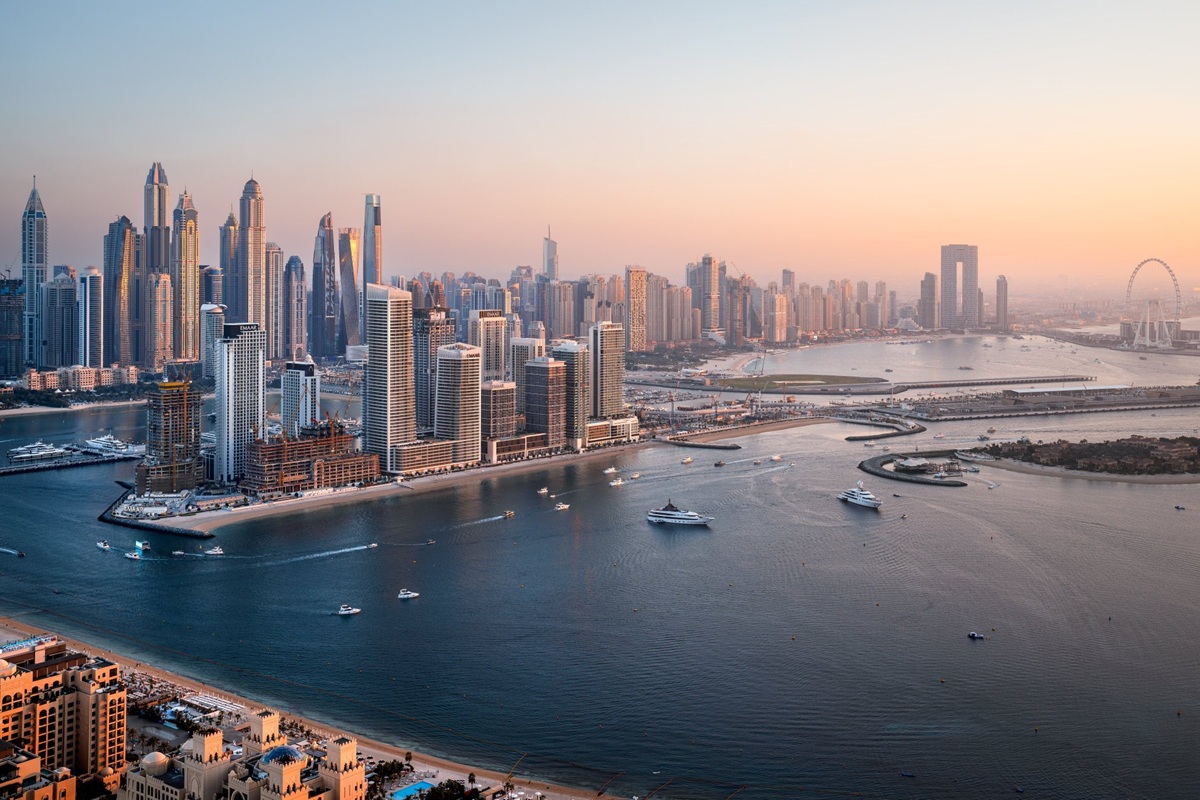
Are property prices coming down in Dubai? It is the most-searched real estate question in the UAE right now — and it deserves a direct answer, not a hedge. The short version: no, prices are not broadly coming down. The longer version is more useful, because what is happening in Dubai property in 2026 varies sharply by segment, and understanding that difference is the difference between making a well-timed decision and missing the market entirely.
No. Property prices in Dubai are not broadly coming down in 2026. The citywide residential average rose approximately 19.8% year-on-year to AED 1,689 per sq ft by end-2025 (ValuStrat). Growth is moderating — Knight Frank forecasts around 3% for prime and around 1% for mainstream in 2026 — but moderating growth is not a price decline. Mid-market apartments in oversupplied communities may see 2–5% softening. Villas, townhouses, and prime waterfront properties are still in structural growth mode, with analyst consensus of 8–12% appreciation for 2026. The market is transitioning from a sprint to a sustainable pace — not reversing.
What the Data Actually Shows: 2025 Into 2026
To answer whether Dubai property prices are coming down, you have to start with where they actually are. In 2025, Dubai's residential market broke every record it had previously set. The Dubai Land Department registered 205,100 residential transactions — an 18.33% increase in volume compared to 2024. Transaction value reached AED 539.9 billion, up 24.67% year-on-year. The citywide weighted-average price hit AED 1,689 per sq ft by December 2025, up 19.8% on the year, according to ValuStrat data.
These are not the conditions that precede a broad market decline. They are the conditions that precede a normalisation — a market finding a sustainable new baseline after exceptional growth. That is a very different thing, and conflating the two has caused a great deal of confusion in the headlines since the Fitch Ratings supply warning was published in mid-2025.
Crucially, 86% of Dubai property transactions are cash-based, according to Knight Frank. This is fundamental to understanding why Dubai does not behave like other markets when sentiment shifts. There are no leveraged buyers facing forced selling. There are no mortgage books at risk of default cascades. The market has a structural floor that simply does not exist in highly leveraged markets like the US, UK, or Australia. When people ask are property prices coming down in Dubai, they are often implicitly importing a framework from those markets — a framework that does not apply here.
Are Dubai Property Prices Coming Down? A Segment-by-Segment Breakdown
The most important insight for 2026 is this: Dubai is not one market. It is many markets operating simultaneously, each with its own supply and demand dynamics. The question of whether property prices are coming down in Dubai cannot be answered with a single yes or no — it has to be answered segment by segment. This table is what no other source is giving you.
| Segment | Price Direction 2026 | Key Reason | Analyst Forecast | Outlook |
|---|---|---|---|---|
| Prime waterfront (Palm Jumeirah, Marina, Downtown) |
↑ Rising | Land-constrained. No meaningful new supply possible. Ultra-HNW demand from 180+ nationalities. Zero vacancy pressure. | +3–8% YoY | Strong Buy |
| Villas & townhouses (Dubai Hills, Arabian Ranches, Damac Hills) |
↑ Rising | Freehold land in established communities is finite. Family demand from relocating HNW residents outpaces supply. No oversupply risk. | +8–12% YoY | Strong Buy |
| Off-plan in master-planned communities | ↑ Rising (entry price) | Off-plan prices currently 20–40% below secondary market. Built-in appreciation as construction progresses. Escrow-protected. | 20–40% below secondary | Opportunity |
| Mid-market apartments (JVC, Arjan, parts of Dubailand) |
→ Softening | High volume of new handovers in 2026. Buyer has more choice. Negotiating position shifts. Rental yields compressing slightly. | –2% to +1% | Selective |
| Ready apartments — secondary market (established mid-tier) |
→ Flat to slight dip | Competition from new off-plan inventory. Older stock in less desirable buildings faces price pressure. Location and quality matter most. | 0% to –5% | Selective |
| Ultra-luxury branded residences (Bvlgari, Armani, Four Seasons) |
↑ Rising | Supply is structurally limited. Global UHNW demand. Safe-haven capital flows from Russia, UK, India, China sustain demand independent of local cycles. | +5–15% YoY | Strong Buy |
| Emerging communities (Dubai South, Expo City, Creek Harbour) |
↑ Rising (long-term) | Infrastructure investment ongoing. Affordability draw. Population growth driving occupancy. Strong rental demand from end-users. | +3–6% YoY | Watch & Buy |
"The question is not whether Dubai property prices are coming down. The question is which segment you are in — because in 2026, they are telling completely different stories."
— Urban Terrace Research Team, March 2026Why Are People Asking If Dubai Property Prices Are Coming Down?
The concern has a legitimate origin. In mid-2025, Fitch Ratings published analysis flagging that approximately 250,000 new residential units were scheduled for delivery in Dubai between 2023 and 2026, with a peak of around 120,000 units expected in 2026 alone. Fitch suggested this supply pipeline could outpace population growth, which is forecasted at approximately 5% annually — and that rental growth rates had already begun to soften.
That was a reasonable observation about one part of the market: mid-tier apartment supply in communities where developers had aggressively launched off-plan projects. What followed, predictably, was a wave of headline-led anxiety that applied a narrow supply analysis to the entire market — as if Palm Jumeirah villas and JVC studios were interchangeable assets operating under the same conditions.
They are not. And that conflation is the root of almost every misleading answer to the question: are property prices coming down in Dubai? The answer requires segment-level analysis — not a citywide headline figure.
More recently, in March 2026, Construction Week reported that developer shares including Emaar and Aldar fell approximately 5% in a single session amid regional security concerns. Some planned capital raisings were postponed. These are real short-term sentiment events — but they are not structural price shifts. Sentiment-driven dips in Dubai have reversed sharply on every prior occasion: post-2008, post-COVID in 2020, and during the 2023–2024 regional conflict period, all of which saw prices recover and then significantly exceed prior highs within 12–18 months.
Are Property Prices Coming Down in Dubai? — 8 Direct Questions Answered
No — not broadly. Citywide residential prices rose 19.8% year-on-year to AED 1,689 per sq ft by end-2025 (ValuStrat). In 2026, the market is moderating its rate of growth, not reversing. Knight Frank forecasts prime price growth of around 3% and mainstream growth of around 1% for the full year. Cushman & Wakefield projects 5–8% overall. The only segment where prices are genuinely softening is mid-market apartments in oversupplied communities — and even there, the movement is 2–5% below peak, not a broad decline. Villas, prime locations, and off-plan in quality master plans continue to appreciate.
Source basis: ValuStrat Dubai Residential City Index Dec 2025, Knight Frank Dubai 2026 Outlook, Cushman & Wakefield Core ForecastPrice softening is concentrated in mid-market apartment communities facing a surge of new handovers — specifically Jumeirah Village Circle, Arjan, parts of Dubailand, and Dubai South's apartment segment. These areas saw the highest volume of off-plan launches between 2022 and 2024, and that supply is now completing. Buyers in these communities have more negotiating power, and listing prices are being adjusted. In contrast, Palm Jumeirah, Downtown Dubai, Dubai Marina, Dubai Hills Estate, and the entire villa/townhouse category remain firm to appreciating. The gap between supply-heavy apartment zones and land-constrained prime communities is widening — not narrowing.
Source basis: BetterHomes Dubai Market Report Feb 2026, Keyper Price Analysis, CBRE Dubai Q4 2025No credible institution or analyst is forecasting a crash. The structural conditions that drove the 2008 Dubai crash — speculative buying with heavy leverage, limited developer regulation, and thin end-user demand — have been systematically addressed. Today, 86% of Dubai transactions are cash-based (Knight Frank). RERA escrow requirements protect off-plan buyers. Developer balance sheets are healthier.
Fitch Ratings, which published the most-cited supply warning, explicitly stated that UAE banks and developers are well-equipped to handle a mild correction. A moderation is not a crash. Dubai has had four previous periods of sentiment-driven price weakness since 2008 — and all four have reversed into new highs.
Source basis: Fitch Ratings UAE Real Estate May 2025, Knight Frank Cash Transaction Data, RERA Annual Report 2025No. Villa and townhouse prices in Dubai are expected to grow 8–12% in 2026 across multiple analyst forecasts. The reason is structural: freehold land in established communities is finite. You cannot simply build more villas in Arabian Ranches, Dubai Hills Estate, or Jumeirah Golf Estates — supply is constrained by geography.
Meanwhile, demand from families relocating under Golden Visa programmes, HNW individuals seeking lifestyle upgrades, and buyers prioritising space and privacy continues to outpace available stock. Average 3-bedroom villa prices stood at AED 2.9M in 2025, with 5-bedroom units reaching AED 13.5M — and both categories are in an upward trend heading into 2026.
Source basis: DLD Average Price Data 2025, Driven Properties Villa Index, Knight Frank Villa Forecast 2026For most buyer profiles, yes — especially in the villa and off-plan categories. The supply-driven softening in mid-market apartments is real, but it also creates a specific opportunity: buyers who previously could not compete with investors in that segment now have more time, choice, and negotiating leverage.
For villas and established communities, the window remains tight — supply is constrained and demand has not softened. For off-plan in quality master plans, the 20–40% discount to secondary market prices provides a structural appreciation buffer even if broader market growth moderates. The historical pattern is instructive: buyers who waited for a crash in 2020 (COVID), 2022 (Ukraine conflict), and 2024 (regional tension) all watched prices rise significantly beyond the entry point they avoided.
Source basis: RERA Escrow Data, DLD off-plan vs secondary price analysis 2020–2025The supply story is real, but it has been broadly misapplied. Fitch Ratings published legitimate analysis about supply pressure in the mid-market apartment segment — but that analysis was absorbed into a general narrative that "Dubai prices are falling." Headlines compress nuance. When Emaar and Aldar shares fell 5% in a single March 2026 session amid regional tensions, that became another data point used to support the falling-prices narrative. Neither the supply analysis nor the equity move tells you what is happening to villa prices, prime waterfront values, or off-plan entry prices in master-planned communities. The market answer to whether property prices are coming down in Dubai requires segment-level data, not citywide fear signals.
Source basis: Fitch Ratings May 2025, Construction Week March 2026, Gulf News property analysisAs of early 2026, Dubai's citywide weighted-average residential value stands at approximately AED 1,689 per sq ft (ValuStrat), with a median of around AED 1,925 per sq ft in prime buildings. For reference: 1-bedroom apartments average AED 1.28 million; 2-bedrooms average AED 2.17 million. 3-bedroom villas average AED 2.9 million and large 5-bedroom villas reach AED 13.5 million.
In prime zones — Palm Jumeirah, Downtown Dubai, Dubai Marina — prices exceed AED 2,000 per sq ft. In emerging communities like Dubai South and Dubailand, more affordable ranges start from AED 700–900 per sq ft. The spread between prime and mid-market is wider than at any point in the past decade.
Source basis: ValuStrat December 2025, DLD Average Price Data, Knight Frank Q1 2025 Community BenchmarksThe medium-term structural case for Dubai property remains as strong as it has been at any point since 2020. Dubai's Urban Master Plan targets a population of 5.8 million by 2040, from approximately 3.8 million today — a 53% increase requiring a proportional expansion in housing stock. The IMF projects UAE GDP growth of 5.0% in 2026, the highest rate among GCC countries and well above the global average.
Golden Visa issuances exceeded 90,000 in 2025, with most recipients purchasing property as part of the residency process. Zero income tax, zero capital gains tax, and a USD-pegged currency remain structurally attractive for capital seeking a stable domicile. For investors with a 3–5 year horizon, the structural answer to whether property prices are coming down in Dubai points firmly in one direction.
Source basis: Dubai Urban Master Plan 2040, IMF World Economic Outlook March 2026, UAE ICP Golden Visa Data 2025Are property prices coming down in Dubai? The honest, data-backed answer is no — not broadly, and not in the segments that matter most to serious investors. The 2026 story is one of selective moderation in supply-heavy mid-market apartments and continued appreciation everywhere else. Villas are rising. Prime waterfront is rising. Off-plan in quality communities remains 20–40% below secondary market value.
The supply headlines are real but narrow in their application. The structural drivers of the Dubai property market — population growth, capital inflow from 180+ nationalities, zero income tax, USD-pegged currency, Golden Visa residency, and political neutrality — are all intact going into the second half of 2026. The investors who wait for a broad crash that the data does not support will, as in every prior cycle, be watching prices from behind.
Prices aren't falling — but the right window is now.